The Bonpilates Monitor Aluminium Reformer with Tower is one of the more common commercial Reformers found in Spanish and southern European Pilates studios, and one this site has direct, extended experience with: thirteen units of this exact model have been purchased and put into regular studio use over several years. This profile combines that hands-on maintenance and operating experience with the manufacturer’s own published specifications, and is written as a technical reference for owners, buyers, and technicians rather than as a review or a sales page. Where a figure or claim could not be independently verified, that is stated explicitly rather than assumed. It is the first entry in this site’s Models series, which will profile specific Reformer, Cadillac, chair, and barrel models to this same standard.
Overview
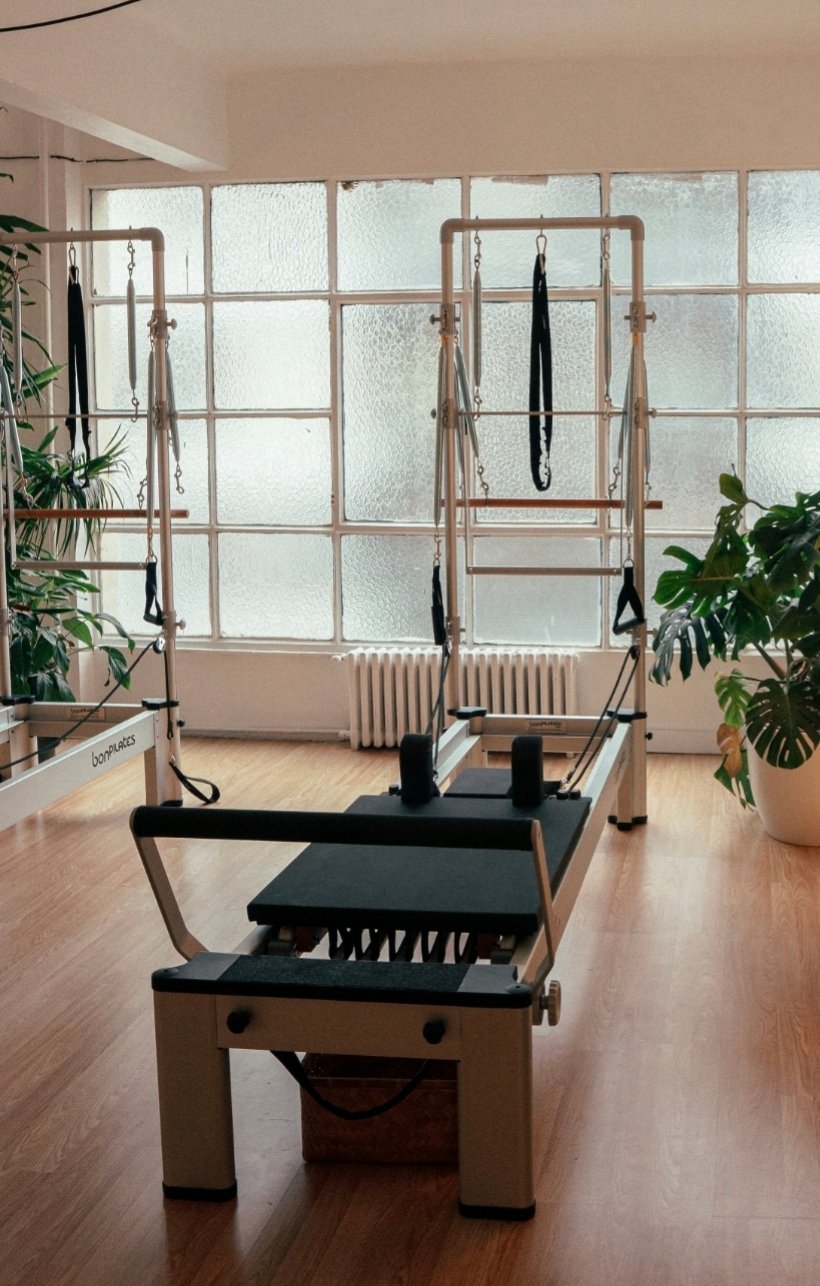
The Monitor is Bonpilates’ aluminium-frame Reformer sold with an integrated tower attachment, positioning it as a combination unit capable of most standard Reformer work plus a large share of Cadillac-style tower exercises. The tower is bolted to the reformer frame at the head end rather than being a separate piece of equipment, which is the defining characteristic of this model within Bonpilates’ range: it is built to let a single machine cover both roles in a studio with limited floor space.
Mechanically, it follows the layout common to modern aluminium Reformers: an aluminium frame and rail system, a rolling carriage supported on wheels, a spring-based resistance system split between the carriage springs and a separate set of tower springs, a multi-position adjustable footbar, and a rope-and-pulley system connecting the carriage to handles and straps. What distinguishes it in daily use is less any single component and more how the whole unit performs under sustained commercial use, which is the focus of the maintenance and problem sections below.
Manufacturer
The Monitor is manufactured by Bonpilates S.L., a Spanish equipment manufacturer based in Alicante. A separate, dedicated overview of the company — its history, product range, and market position — is available on the Bonpilates Brand Guide; this article stays focused on the Monitor model itself rather than repeating that company-level background.
Main Specifications
The following specifications are taken from Bonpilates’ own published product data for the Monitor Aluminium Reformer with Tower (reference 81000047):
- Frame material: Aluminium
- Design line: Modern
- Push-through bar material: Metal (Bonpilates’ own published materials are not fully consistent about the exact alloy — see FAQ; a wooden alternative is also available)
- Overall dimensions: 248 × 77 × 204 (units and axis order as published). Bonpilates’ own listing does not specify which figure corresponds to length, width, and height, so these numbers should be treated as approximate footprint and height references rather than confirmed length/width/depth values. If exact clearances matter for your studio layout, measure a unit directly or confirm the axis order with the manufacturer before ordering.
- Footbar: More than 20 positions
- Carriage springs: 5 springs, each a different resistance and colour
- Tower springs: 8 springs, each a different resistance and colour
- Fixed carriage: No — the carriage is free-rolling, not lockable in place
- Shoulder rests: Removable and interchangeable with each other to alter their spacing; not adjustable via a sliding or multi-position mechanism
- Headrest: 3 positions
- Straps and handles: Sets of strings attached to double-padded handles
- Pulley height: Adjustable
- Wheels: Fitted as standard
- Included accessories: Box and mat converter
The shoulder rests are fixed in use and do not slide or lock into multiple positions. Bonpilates currently describes them as removable and interchangeable with each other to alter the spacing, but this should not be confused with a conventional adjustable shoulder-rest system: removable and interchangeable are not the same thing as adjustable. On the units reviewed and used by Pilates Spare Parts, there is no sliding or multi-position adjustment mechanism for the shoulder rests.
The Reformer set includes a complete set of springs, a complete set of handles, a rope set, a foot strap, the box, and the mat converter. The tower set includes its own complete spring set, a nylon handle with a neoprene grip, a safety strap, a wooden breathing bar, and an metal push-through bar. A jump board is not included by default and is sold separately.
Construction
The frame and rail system are aluminium, which is the main reason this model is noticeably lighter than steel-framed Reformers of a similar footprint. In practice, this lighter build is one of the most immediately noticeable traits of the Monitor: it is easier for one person to reposition within a studio, easier to load into a vehicle for mobile setups, and generally less physically demanding to move than comparable steel machines. That same lighter construction is also the underlying reason several of the wear patterns described later in this profile — particularly around the tower and its attachment hardware — show up sooner than they would on a heavier, steel-tower design.
Like most aluminium-frame Reformers, the Monitor’s construction relies on bolted joints rather than welded ones, which is also consistent with how straightforward these units are to partially disassemble for transport — a relevant point for mobile instructors or studios that relocate equipment between rooms. Bolted aluminium construction is not inherently less durable than welded steel, but it does mean that fastener integrity across the whole frame, not just at the tower, is worth including in a periodic maintenance pass rather than assuming a bolted joint tightened at the factory stays tight indefinitely under repeated loading.
Carriage
The carriage rolls on wheels along the aluminium rail system and is not fitted with a locking mechanism, so it moves freely whenever weight is placed on it. Carriage padding is upholstered, and across the thirteen units purchased for this profile, firmness of that padding has not been fully consistent unit to unit — some carriages arrived noticeably firmer or softer than others despite being the same model and specification. This is a manufacturing variance worth being aware of if you are buying more than one unit and expect them to feel identical; it is not something that shows up in the published specifications, and it is the kind of detail only apparent once several units are compared side by side in the same space.
Carriage wheel and rail behavior follows the same general principles covered in this site’s dedicated guide to Reformer wheels: wheel and bearing condition, plus rail cleanliness, determine how smoothly the carriage moves. On the Monitor specifically, rail cleanliness has turned out to matter more than on some other models — see Real-World Maintenance Experience below.
Tower
The tower attaches at the head end of the frame and carries its own spring set (eight springs), a nylon handle with a neoprene grip, a safety strap, a wooden breathing bar, and an metal push-through bar. Functionally, it extends the machine to cover most Cadillac-style work without requiring a separate piece of equipment.
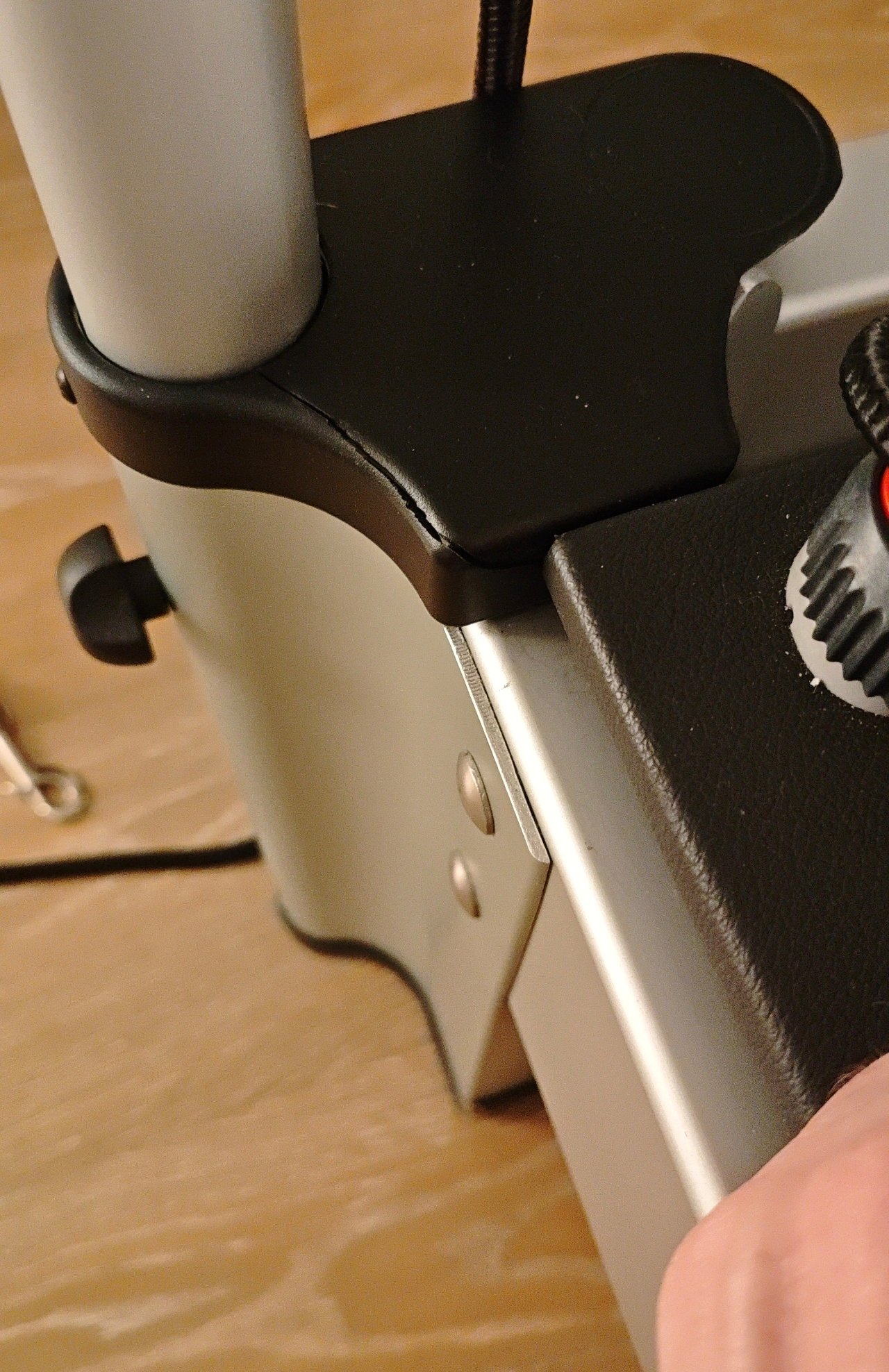
In sustained commercial use, the tower is the part of the Monitor that has needed the most attention. Two issues show up consistently. First, the plastic trim covering the tower’s base connection — where the tower meets the frame — is prone to cracking. It is a cosmetic, non-structural piece, but it is reliably one of the first parts to fail on a unit that sees regular use, and it is worth checking periodically rather than waiting for it to become visibly damaged. Second, the tower’s mounting hardware (the bolts and fittings holding the tower to the frame) benefits from periodic checking and re-tightening; because the tower is a cantilevered structure attached to a lightweight aluminium frame, hardware that loosens gradually under repeated push-through-bar loading is a normal maintenance item here rather than a one-off defect. Taken together, the tower on this model has felt comparatively less robust than the reformer base it’s attached to — not unreliable, but clearly the part of the machine that ages fastest and needs the closest periodic attention.
Springs
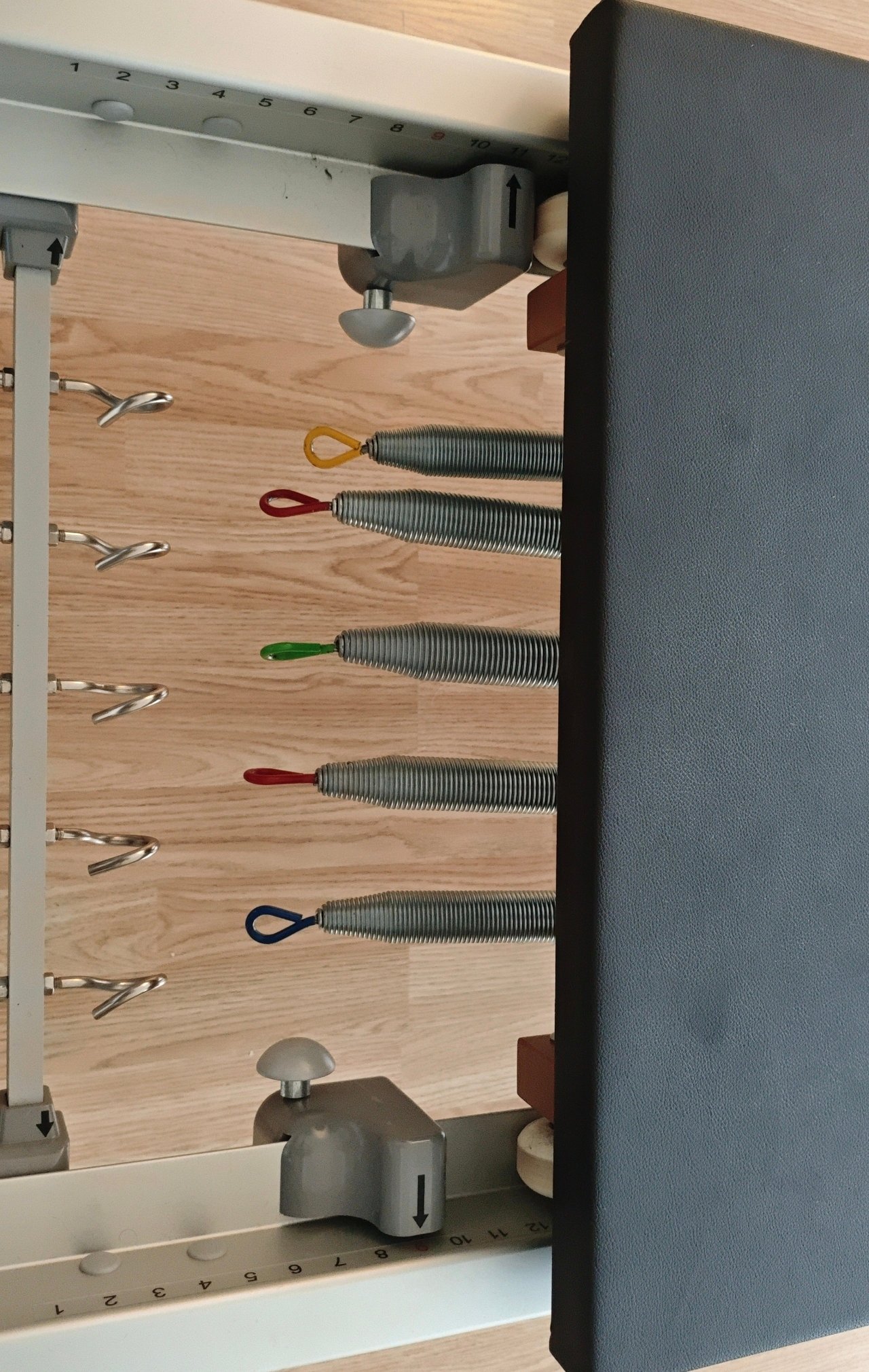
The Monitor uses two separate spring systems: five carriage springs for standard Reformer resistance, and eight tower springs for tower work, each set colour-coded by resistance. This split system is standard for tower-equipped Reformers and lets the two functions be adjusted independently. General information on how tension springs generate resistance, spring materials, and how to judge spring condition is covered in this site’s Reformer springs guide; that guidance applies directly to both spring sets on this machine. Bonpilates’ own maintenance documentation recommends replacing springs every two years for tension and safety reasons, which is a reasonable baseline regardless of visible wear, since spring fatigue is not always apparent from appearance alone.
Footbar
The footbar offers more than twenty positions, which is a generous range compared to many Reformers and useful for accommodating a wide range of body sizes and exercise variations. In use, the footbar’s locking mechanism can loosen over time with repeated adjustment and loading, to the point where it no longer holds its set position firmly. This is not something that appears immediately on a new unit, but on machines in daily studio rotation it becomes a recurring check item — footbar tightness is worth confirming as part of routine maintenance rather than only when a problem is reported.
Straps and Ropes
The Reformer and tower straps are sets of strings (ropes) attached to double-padded handles, plus a dedicated safety strap on the tower. Under regular studio use, these straps fray over time, which is expected wear for any rope-and-fabric strap system rather than a defect specific to this model — the practical implication is that strap condition should be part of routine visual inspection, since a frayed strap is a foreseeable failure point before it actually breaks. General rope material, construction, and replacement guidance is covered in this site’s Reformer ropes guide.
Upholstery
Upholstery on the carriage, shoulder rests, and headrest is a standard vinyl-type surface, cleaned according to Bonpilates’ own instructions with water and a microfiber cloth, and a mild detergent diluted in water for stains. As noted in the Carriage section above, padding firmness under that upholstery has shown measurable variance across units from the same production run, which is worth checking directly if consistency across multiple machines matters for your studio.
Real-World Maintenance Experience
Across thirteen units operated over several years, a handful of maintenance habits have made the most practical difference in keeping these machines running well. Carriage rail cleaning stands out specifically on this model — more so than on some heavier, steel-frame Reformers — because the aluminium rail and carriage system on the Monitor seems to pick up and hold dust and grit readily, and a rail that isn’t cleaned regularly translates quickly into a carriage that no longer glides smoothly. Bonpilates’ own documentation supports this, recommending periodic cleaning and lubrication of the carriage rail guides, the wheels, and the spring regulating bars to keep the wheels sliding smoothly and the spring hooks moving as intended.
Beyond rail cleaning, the routine that has worked well in practice is a short periodic check covering: the tower’s mounting hardware for looseness, the footbar’s locking mechanism for firm hold, the condition of the straps and ropes for fraying, and the plastic tower-base trim for cracking. None of these are difficult or time-consuming individually, but skipping them for months at a time is what tends to turn a minor, cheap fix into a more disruptive one — a loose footbar or tower bolt is a five-minute check, but the same issue ignored for a year can mean a class interruption or a part that needs replacing rather than tightening.
The lightweight aluminium build is worth mentioning again here specifically in a maintenance context: it makes the machine genuinely easier to move for cleaning underneath and around, and easier to reposition without needing two people, which in practice means rail and frame cleaning actually gets done more consistently than it might on a heavier unit that’s awkward to move.
Common Problems
Based on the wear patterns observed across the units in service, the recurring issues on this model, roughly in order of frequency, are:
- Cracked tower base trim — the plastic trim covering the tower’s base connection is the most commonly recurring cosmetic failure; it does not affect structural safety but is worth monitoring and budgeting for as a replaceable wear part.
- Loose tower mounting hardware — bolts and fittings at the tower-to-frame connection can work loose under repeated push-through-bar use and need periodic re-tightening.
- Loosening footbar — the footbar’s locking mechanism can lose its hold over time and needs occasional checking, particularly on units used heavily throughout the day.
- Frayed straps and ropes — expected wear on any rope-and-fabric strap system, more noticeable the more hours a unit sees.
- Carriage rolling roughly — usually traceable to a dirty carriage rail rather than a wheel or bearing fault; cleaning the rail resolves the majority of these cases.
- Inconsistent carriage padding firmness between units — a manufacturing variance rather than a wear issue, but relevant if you’re buying multiple units and expect uniformity.
- Shoulder rests are not adjustable via a sliding or multi-position mechanism — they can be removed and swapped with each other to change spacing, but there is no conventional adjustment system on the units reviewed.
None of these issues, individually or collectively, have made the model unsuitable for intensive studio use — used across thirteen units over several years, it has proven to hold up well to daily commercial rotation. The pattern is closer to a machine with a handful of predictable, manageable wear points than one with a single serious design flaw.
Buying This Model Used
If you are evaluating a used Monitor, the checks that matter most, based on the issues above, are: inspect the plastic trim at the tower’s base for cracks or missing sections, check the tower’s mounting hardware for looseness by applying moderate pressure to the tower while watching the base connection, confirm the footbar locks firmly at multiple positions rather than slipping under load, check all straps and ropes for fraying or thinning (particularly near the pulleys and handle attachments), and press on the carriage padding to get a sense of its firmness compared to other units if you have more than one to compare. None of these are disqualifying on their own — they are the same wear points documented throughout this profile — but their presence or absence is a reasonable indicator of how well a specific unit has been maintained rather than how many hours it has logged, since these are maintenance-dependent issues rather than purely mileage-dependent ones.
It’s also worth checking that the unit includes its full accessory set — box, mat converter, and the tower’s breathing bar and push-through bar — since these are sold as part of the standard package and are not always included by sellers of used units.
Beyond the tower and footbar checks, it’s worth running the carriage the full length of the rail while watching and listening for anything other than a smooth, quiet roll, checking that both carriage and tower spring hooks engage cleanly without visible deformation, and looking over the upholstery seams for separation rather than just surface wear. None of these are unique to this model, but they’re a useful complement to the model-specific checks above when assessing a used unit’s overall condition rather than just its cosmetic state.
Spare Parts Availability
As a current-production model from an active Spanish manufacturer, replacement springs, straps, ropes, and upholstery for the Monitor are generally obtainable through Bonpilates directly or through authorized distributors; exact part numbers and pricing are best confirmed directly with the manufacturer or seller for your region, since this varies by market and was not independently verified for every part category. For component-level detail that applies beyond this specific model — how springs, ropes, and wheels are built, wear, and get judged for quality — see this site’s Components hub. The plastic tower-base trim, being a wear part specific to this design, is worth confirming availability of directly if you’re planning to keep a unit in service long-term, given how often it appears in the common problems list above.
If you operate more than one Bonpilates model, it’s also worth asking the manufacturer directly which components are shared across their Reformer range versus specific to the Monitor — spring sets, straps, and upholstery in particular are frequently shared across a manufacturer’s line, which can simplify inventory for a studio running mixed equipment, but this has not been independently verified part-by-part for Bonpilates’ current catalogue and should be confirmed before assuming interchangeability.
Engineering Notes
A few points are worth noting from a mechanical design perspective, based on how this model behaves in service rather than on its published specification sheet. The core design tradeoff of the Monitor is weight versus rigidity at the tower connection: the aluminium frame keeps the whole unit light and easy to handle, which is a genuine practical advantage in a working studio, but it also means the tower — a cantilevered structure loaded repeatedly and sometimes forcefully during push-through-bar exercises — is asking more of a lighter connection than it would on a heavier steel frame. That tradeoff is consistent with, and helps explain, why the tower-area issues (trim cracking, hardware loosening) are the dominant wear pattern on this model rather than problems with the reformer base itself, which has generally proven durable.
The split spring system (five carriage springs, eight tower springs) is a sound approach for a combination unit, since it lets carriage resistance and tower resistance be tuned independently rather than sharing a single spring bank, which would compromise one function or the other. The non-fixed carriage (no locking mechanism) is standard for this class of Reformer and is not itself a design shortcoming, though it’s worth being aware of for instructors used to lockable carriages on other equipment.
The tower-base trim failure pattern is also worth understanding mechanically rather than treating as a random defect: the trim sits at a point that absorbs both the static weight of the tower and the dynamic, repeated loading transmitted through the push-through bar during exercise. A plastic component at that junction is doing cosmetic work — covering the actual structural fasteners — but it still experiences real flex and vibration over thousands of repetitions, which is consistent with why it fails more predictably than the metal structure it covers. This also explains why simply replacing the trim, without checking the hardware underneath it, addresses the symptom but not necessarily the underlying cause if the mounting bolts have also loosened.
Pros
- Significantly lighter than comparable steel-frame Reformers, making it easier to move, reposition, and transport.
- Combination Reformer-and-tower design saves floor space compared to running separate units.
- Wide footbar adjustment range (20+ positions) accommodates a broad range of body sizes.
- Independent carriage and tower spring systems allow resistance to be tuned separately for each function.
- Has proven reliable for intensive, daily commercial studio use across multiple units over several years, provided the routine checks described above are followed.
Cons
- The tower is comparatively fragile relative to the reformer base, with the plastic base trim and mounting hardware needing periodic attention.
- Footbar locking mechanism can loosen with heavy use and needs occasional checking.
- Straps and ropes fray with regular use, as expected for this strap type, but worth including in routine inspection.
- Carriage rail requires more frequent cleaning than some steel-frame alternatives to keep the carriage rolling smoothly.
- Manufacturing variance observed in carriage padding firmness across units of the same specification.
- Published dimensions do not specify axis order, making precise footprint planning harder without measuring a unit directly.
Who Is This Machine For?
The Monitor suits studios that need a combination Reformer-and-tower unit and value ease of moving equipment — whether that’s rearranging a studio floor for different class formats, or running a space where machines get repositioned regularly. Its light weight is a genuine practical advantage for solo studio owners or small teams without dedicated equipment-moving help. It is well suited to intensive daily group and private class use, provided the tower hardware, footbar, and straps are included in a routine maintenance check rather than left unchecked between services. It is less immediately suited to buyers specifically prioritizing maximum tower rigidity above all else, or to those who want a single, less involved maintenance routine and would rather trade some space efficiency for a simpler machine with fewer periodic checks.
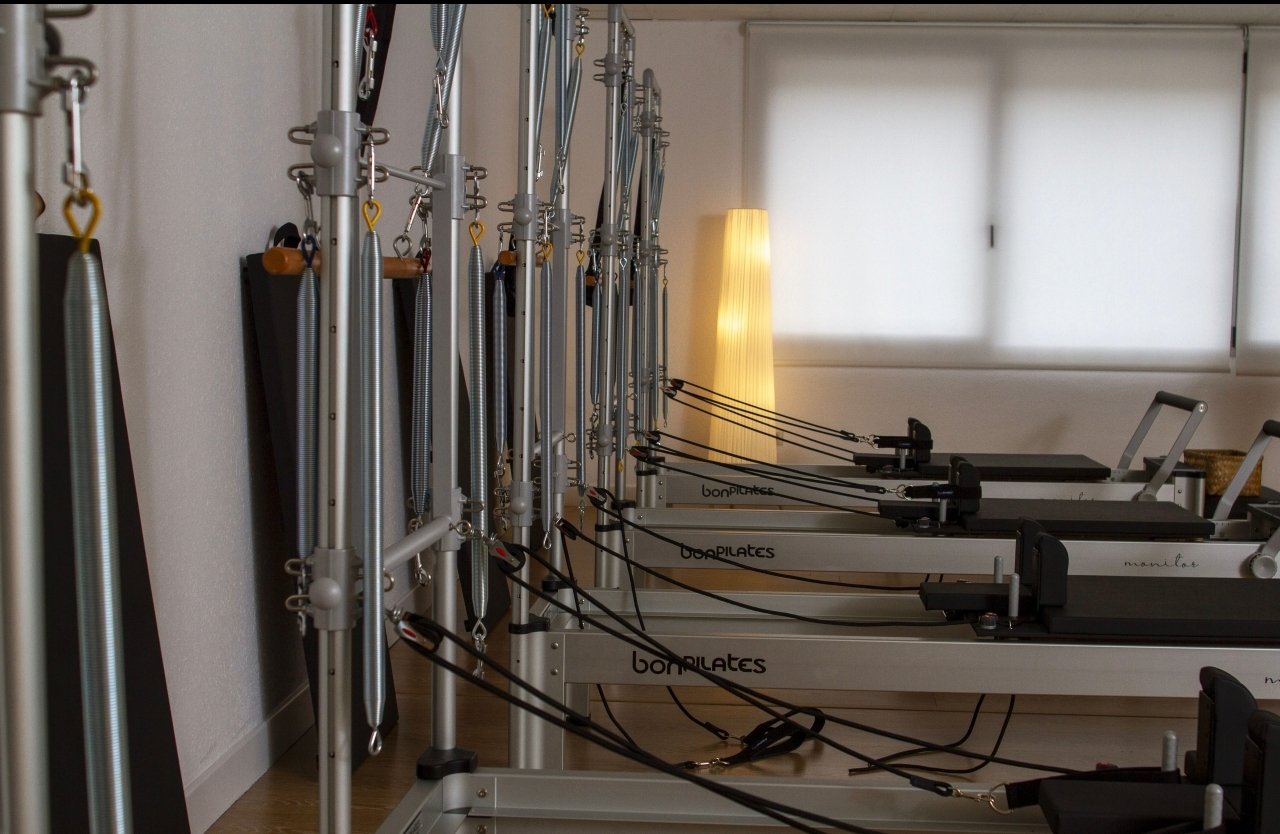
This is also, in practice, a machine that scales reasonably well to multi-unit studio fleets — the group of units shown above reflects the kind of environment where its maintenance patterns are most visible, since issues that might go unnoticed on a single home-studio unit tend to surface faster, and more informatively, once several machines are running the same class schedule side by side.
FAQ
What is included with the Bonpilates Monitor Aluminium Reformer with Tower?
The standard package includes the Reformer with its complete spring set, complete handle set, rope set, and foot strap, plus the box and mat converter accessories. The tower comes with its own complete spring set, a nylon handle with neoprene grip, a safety strap, a wooden breathing bar, and an metal push-through bar.
Is the push-through bar wood or steel?
The standard push-through bar is metal. Bonpilates’ own published materials are not fully consistent on the exact alloy — some describe it as steel, others as aluminium — so this profile does not state one as confirmed; the exact alloy would need direct verification. Bonpilates also offers a wooden push-through bar as an alternative, though fitting the wooden version leaves a gap of roughly 2.5 cm on each side, according to the manufacturer’s own documentation.
Does the Monitor include a jump board?
No. A jump board is not part of the standard package and needs to be purchased separately. The box and mat converter are included as standard accessories, but the jump board is not.
How many springs does the Monitor use?
Five carriage springs of different resistances and colours for standard Reformer work, and a separate set of eight tower springs, also colour-coded by resistance, for tower exercises.
Is the carriage lockable?
No. Bonpilates lists the carriage as non-fixed, meaning it rolls freely whenever weight is applied and has no locking mechanism.
What is the frame made of?
The frame is aluminium, which is the main reason this model is noticeably lighter than steel-framed Reformers of similar size.
How often should the springs be replaced?
Bonpilates’ own maintenance guidance recommends replacing springs every two years for tension and safety reasons, regardless of whether wear is visually apparent.
What is the most common issue with this model?
In practice, across multiple units used commercially over several years, the plastic trim covering the tower’s base connection is the most frequently recurring issue — it is a cosmetic wear part prone to cracking rather than a structural or safety concern.
Does the tower need regular maintenance?
Yes. Because the tower is a cantilevered attachment on a lightweight aluminium frame, its mounting hardware benefits from periodic checking and re-tightening, particularly on units that see heavy push-through-bar use.
Why does the carriage sometimes feel like it’s not rolling smoothly?
This is most often traced to a dirty carriage rail rather than a wheel or bearing problem on this model. Regular rail cleaning resolves the majority of rolling-smoothness complaints observed in service.
Are all Monitor units identical out of the box?
Largely, yes, in terms of specification, but some manufacturing variance has been observed in carriage padding firmness across units from the same production run. This is worth checking directly if you’re purchasing several units and expect them to feel identical.
Can this Reformer be used for both Reformer and Cadillac-style exercises?
Yes — the integrated tower is specifically what allows this model to cover most standard Reformer exercises as well as most tower-based (Cadillac-style) exercises without needing a separate piece of equipment.
How does the Monitor compare in weight to steel Reformers?
It is noticeably lighter, owing to its aluminium frame, which makes it easier for one person to reposition or transport compared to steel-framed alternatives of a similar footprint.
What should I check when buying a used Monitor?
Inspect the tower base trim for cracks, check tower mounting hardware for looseness, confirm the footbar holds firmly at multiple positions, check straps and ropes for fraying, and check that the full standard accessory set (box, mat converter, breathing bar, push-through bar) is included.
Where can replacement parts be sourced?
Springs, straps, ropes, and upholstery are generally available through Bonpilates directly or through authorized distributors. Exact availability and part numbers vary by region and are best confirmed directly with the manufacturer or seller.
What are the machine’s overall dimensions?
Bonpilates publishes 248 × 77 × 204 as the overall measurements but does not specify which figure corresponds to length, width, or height. Treat these as approximate reference figures rather than confirmed axis-by-axis dimensions, and measure a unit directly if exact studio clearances matter.
Conclusion
The Bonpilates Monitor Aluminium Reformer with Tower is, in practical terms, a lightweight combination Reformer that has held up well to intensive commercial studio use across the thirteen units this profile draws on, provided a small set of predictable wear points — the tower base trim, tower mounting hardware, footbar locking, and strap condition — are checked periodically rather than left unattended. Its aluminium construction is both its clearest practical advantage and the underlying reason its tower ages faster than the reformer base itself. For studios that value floor-space efficiency, combination functionality, and ease of moving equipment, and that are willing to build these checks into routine maintenance, it is a machine that performs reliably over years of daily use.