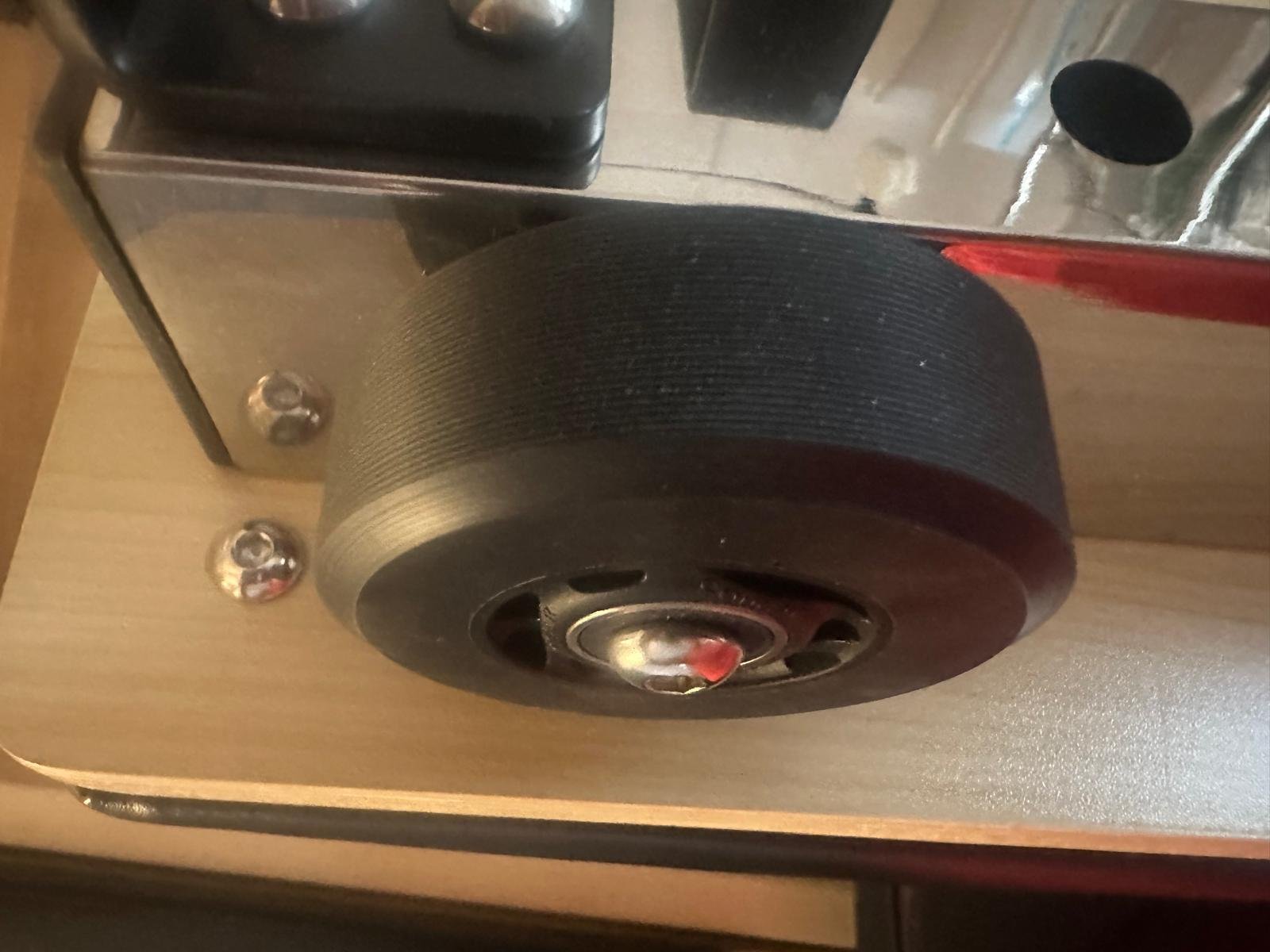
Introduction
Every time a Pilates Reformer carriage glides down the rail, the quality of that movement passes through four small components: the wheels. Nobody buys a Reformer because of its wheels, and few instructors could name the material theirs are made from. Yet the wheels determine whether a carriage feels smooth and controlled or gritty and unpredictable, and they are the one component that is always in motion, always under load, and always in contact with a hard surface.
Wheels rarely get the technical attention they deserve. Springs get discussed because they relate directly to resistance. Straps and ropes, and the pulleys that guide them, get discussed because they fail visibly. Wheels wear slowly and quietly, and by the time the carriage feels “off,” the wheels have often been degrading for months. Understanding how they work, what they are made of, and how they fail is the difference between replacing a wheel set proactively as routine maintenance, and discovering a cracked wheel mid-class. For a broader look at every wear component on a Reformer, see our guide to the parts that wear out on a Pilates Reformer, or browse the full Components library.
This is a mechanical guide, not a buying guide. It does not promote any manufacturer. It is written for the people who deal with these machines day to day: studio owners, maintenance technicians, distributors, and instructors who want to understand what is happening under the carriage they use every day.
How the Carriage System Works
Before discussing the wheels themselves, it helps to understand the system they belong to. A Reformer’s carriage does not float on the frame; it rolls along a fixed track using a small, precise wheel-and-rail assembly.
The rail
The rail (or track) is the fixed metal channel running the length of the frame, usually aluminum or steel, surface-treated to resist corrosion and reduce friction. It is both the running surface the wheels roll on and the boundary that keeps the carriage traveling in a straight line. Any irregularity — a dent, a build-up of residue, a worn section of coating — transmits directly into the wheels and, eventually, into the feel of the stroke.
The carriage
The carriage is the moving platform the user lies, sits, or kneels on: a rigid welded or bolted frame with wheel assemblies mounted at each corner or along the sides. Because it supports body weight plus spring tension plus movement momentum, the wheels are never just holding a static load — they constantly absorb changing radial, and to a lesser extent lateral, forces as the user shifts position.
Wheel arrangement
Most Reformers use four primary wheels, one near each corner, though the exact arrangement varies by manufacturer. Some designs add secondary guide wheels to control lateral movement independently from the load-bearing wheels. There is no single industry-standard layout — what matters mechanically is that carrying vertical load and constraining horizontal movement are two separate jobs, and manufacturers split that work between wheels differently.
Upper, lower, and guide wheels
On many Reformers, the primary wheels run on top of the rail and carry most of the carriage’s weight. Some designs also use lower wheels or side-mounted guide wheels riding against the underside or inner faces of the rail, preventing the carriage from lifting, tilting, or drifting sideways. Guide wheels typically carry far less load than the primary wheels but are just as important for a stable feel, since they stop the carriage from rocking or wandering laterally under an off-center push.
Engineering note — radial loads: A radial load is a force applied perpendicular to a wheel’s axis of rotation — here, the downward weight of the user and carriage pressing the wheel against the rail. Reformer wheels are designed primarily around this constant radial load. Lateral (axial) loads exist too, from side-to-side movement, but they are secondary. This is why uneven wear is diagnostic: a wheel worn more on one face than the other has usually been absorbing lateral load it wasn’t primarily designed for, which typically points to misalignment rather than a defective wheel.
Alignment and tolerances
The clearance between wheel and rail, and the parallelism between wheels on either side of the carriage, is a tolerance range designed by the manufacturer — tight enough to prevent wobble, loose enough that the wheel doesn’t bind or generate excessive rolling resistance. This clearance is rarely published as a spec number, so technicians generally judge alignment by feel and symptom rather than measurement. A carriage with excessive play feels loose and unstable; one that is over-tightened or has debris in the rail feels stiff or gritty even with the springs unloaded.
Types of Reformer Wheels
Manufacturers do not use one universal wheel design, and the differences reflect different priorities around noise, load capacity, and cost — not any single “correct” approach.
- Single-flanged wheels: a raised lip on one side rides against the inner rail edge for lateral guidance. Common in simpler, lower-cost designs.
- Double-flanged wheels: flanges on both sides constrain lateral movement without a separate guide wheel, reducing part count but sometimes adding rolling resistance if clearances are tight.
- Grooved (V- or U-groove) wheels: a machined channel rides over a matching ridge on the rail, similar to a sliding-door roller. This self-centers the carriage to some degree and favors a quiet glide.
- Flat-profile wheels with separate guide wheels: a flat or slightly crowned wheel carries vertical load only, paired with smaller horizontal guide wheels for lateral control. Splitting the two jobs can make each component simpler and cheaper to replace individually.
- Dual-wheel or tandem carriages: two wheels per corner distribute load across more contact area, more common on commercial machines built for high load cycling.
The practical takeaway: don’t judge a Reformer as better or worse purely by which configuration it uses. A well-made wheel in a simple design will usually outlast a poorly made wheel in an elaborate one. Material, bearing quality, and maintenance matter more than the configuration itself.
Materials Used
The wheel’s material is the biggest factor in how it performs and fails. Reformer wheels are almost always one of a small number of engineering polymers, occasionally combined with a metal or composite core. None is universally “best” — each balances grip, noise, load capacity, and longevity differently.
Polyurethane
The most common material in modern Reformer wheels, offering a strong combination of abrasion resistance, load capacity, and a relatively quiet ride. In general industrial use, polyurethane wheels are documented as offering roughly three to five times the abrasion resistance of standard rubber at comparable hardness and diameter — a major reason it has become the default choice for equipment casters and machine wheels well beyond fitness equipment. Typical general-purpose polyurethane wheels are molded around Shore A 85–95, with harder formulations (Shore D 60–70) used where load capacity matters more than cushioning. Reformer manufacturers do not generally publish the exact durometer of their wheels, so specific figures should be treated as unpublished rather than assumed.
Engineering note — Shore hardness: Shore hardness is a standardized scale for measuring a polymer’s resistance to indentation, used to describe how firm or soft a material is. The Shore A scale (0–100) is used for softer, more flexible materials like most polyurethanes and rubbers; the Shore D scale is used for harder, more rigid plastics. A higher number means a firmer material that resists deformation better but cushions less — which is why a very hard wheel rolls efficiently and resists flat-spotting but transmits more noise and vibration, while a softer wheel absorbs shock quietly but compresses more under sustained load.
Nylon
Harder and more rigid than polyurethane, giving excellent wear resistance and dimensional stability under load, at the cost of a noisier, harder-feeling ride. Nylon also absorbs moisture from the air (typically 1–3% by weight), which can cause slight swelling in humid climates — relevant for coastal or humid studios. Its main advantage is cost and durability in dry, high-load conditions; its drawback in a Reformer is more transmitted noise and vibration than a comparable polyurethane wheel.
Delrin (acetal / POM)
Delrin is a trade name for acetal homopolymer (POM). It absorbs very little moisture (around 0.2%, far lower than nylon), so it holds machined tolerances more consistently across humidity changes. Its abrasion resistance is close to nylon’s, slightly lower in most published comparisons, with a notably low, steady-state wear rate under continuous load. Delrin appears less often than polyurethane or nylon in Reformer wheels, but shows up in some designs, particularly smaller guide wheels where dimensional precision matters more than shock absorption.
Rubber
More common on older and vintage Reformers, prized for a quiet ride and good grip. Its major drawback is durability: rubber wears faster than polyurethane under equivalent load and mileage, and is more prone to hardening, cracking, and surface degradation, especially with UV or ozone exposure. Rarely used on new commercial Reformers today, but technicians servicing older machines will still encounter it and should expect a shorter service life than a modern polyurethane wheel of similar size.
Composite and hybrid materials
Some manufacturers bond a rigid core (nylon or glass-filled polymer) to a polyurethane tread, combining core rigidity with the noise and grip benefits of a softer outer layer — an approach borrowed from industrial and material-handling casters. These wheels can offer a genuinely good balance of properties, but are more complex to manufacture, and when they fail, tend to fail at the bond line between core and tread rather than through simple surface wear.
| Material | Typical feel | Abrasion resistance | Noise level | Moisture sensitivity | Best suited to |
|---|---|---|---|---|---|
| Polyurethane | Cushioned, smooth | High | Low | Low | General commercial and home use |
| Nylon | Firm, rigid | High | Higher | Moderate (1–3% absorption) | High-load, dry environments |
| Delrin (acetal/POM) | Firm, precise | Moderate–high | Moderate | Very low (~0.2%) | Precision guide wheels |
| Rubber | Soft, quiet | Lower | Very low | Low, but UV/ozone sensitive | Vintage or low-cycle machines |
| Composite/hybrid | Varies by design | High (core-dependent) | Low–moderate | Depends on outer material | Heavy commercial use |
Bearings
The wheel material governs how the surface interacts with the rail. The bearing governs how freely the wheel rotates, and matters just as much — a worn bearing inside a perfectly good wheel still produces a rough, gritty stroke.
Sealed vs. shielded vs. open
Reformer wheel bearings are typically small radial ball bearings, similar in principle to those in skate and caster wheels, in three configurations: open (balls exposed, easiest to contaminate), shielded (a fixed metal cover, moderate protection), and sealed (a rubber or plastic cover forming a tighter barrier). Sealed bearings are generally preferred in a studio environment — dust, carpet fibers, occasional spilled water — exactly the conditions that degrade an open or shielded bearing fastest.
Precision and the ABEC system
Bearing precision is sometimes described with the ABEC rating, an industry classification for manufacturing tolerances (bore consistency, raceway runout) on an odd-numbered scale from 1 to 9. It measures dimensional precision only — not load capacity, material quality, ball roundness, or lubrication — so a lower-ABEC bearing made from better materials can outperform a higher-ABEC bearing in practice. For a component rotating at relatively low speed like a Reformer wheel, build quality and sealing matter more than raw ABEC precision.
Noise as a diagnostic signal
A healthy bearing is essentially silent or produces only a faint, consistent rolling sound. Grinding, clicking, or a pitch-changing tick point to bearing wear — pitting, a damaged ball, lost lubrication — rather than wheel-material wear. Replacing the wheel’s outer material without addressing a worn bearing underneath will not resolve the noise.
Maintenance and service life
Most Reformer wheel bearings are sealed units not designed to be re-lubricated or serviced individually; when one degrades, standard practice is to replace the bearing (or the wheel assembly it’s pressed into). Service life varies enormously with use: a home Reformer used a few times a week may keep its original bearings for years, while a studio machine cycling through multiple classes daily accumulates rotational wear far faster.
Why Wheels Wear Out
Wheel wear is rarely one factor alone — usually normal use plus one or two accelerating conditions determine whether a set lasts five years or eighteen months.
- Abrasion: every rotation removes a microscopic amount of material through friction — normal and unavoidable, but accelerated sharply by a dirty rail, embedded grit, or a wheel material too soft for its load.
- Fatigue: repeated loading and unloading cycles cause rolling fatigue, where microscopic subsurface cracks develop long before visible damage appears, eventually surfacing as flat-spotting or chunking even without abuse.
- Deformation: softer polymers, especially polyurethane, can develop a permanent flat spot (compression set) if the carriage is left stationary under load in the same position for an extended period, such as storage with springs attached.
- Dirt and contamination: dust, hair, chalk, and skin oils accumulate on rails and in bearings; hard particulate trapped between wheel and rail acts as an abrasive.
- Misalignment: a wheel not tracking squarely — from a bent axle, loose mount, or a rail slightly out of parallel — wears unevenly and accelerates bearing wear, sometimes damaging the rail itself.
- Overload: every wheel is engineered around an assumed combined load; advanced or high-momentum exercises, or users heavier than that assumption, add radial and impact load with every repetition, shortening fatigue life.
- Use intensity: a studio Reformer used in eight to ten classes a day accumulates rolling cycles no home machine approaches — simply a function of total distance and load cycles.
- Poor storage: humid environments, direct sunlight, and temperature swings accelerate degradation — rubber is especially vulnerable to UV and ozone cracking, and some polymers become more brittle in cold storage.
Engineering note — friction and rolling resistance: The coefficient of friction between a wheel and its rail determines how much force is needed to keep the carriage moving, and how much energy is lost as heat with every stroke. A very low-friction wheel glides with minimal resistance but can feel disconnected or “slippery” underfoot; a higher-friction surface feels more planted but requires more effort to move and generates more frictional heat over time, which is one of the mechanisms behind gradual surface degradation in softer polymers. This is also why keeping the rail clean matters mechanically, not just cosmetically: contamination changes the effective coefficient of friction at the contact surface, which changes both the feel of the stroke and the rate of wear.
Signs That Wheels Need Replacement
Most wheel failures announce themselves gradually through sound, feel, and visible condition, well before an actual failure.
- Noise: a new grinding, clicking, squeaking, or rumbling sound, especially if rhythmic and repeating with each rotation.
- Vibration: a noticeable buzz at consistent carriage speed, often pointing to a flat spot or bearing damage.
- Irregular movement: hesitation, minor catches, or a stroke that isn’t smooth end to end — suggests a flat-spotted wheel or debris in the rail.
- Play or looseness: detectable side-to-side or up-and-down movement when gently rocking the unweighted carriage by hand, indicating bearing wear, a loose axle, or worn wheel material.
- Flat-spotting: a visibly flat section on what should be a round profile.
- Cracks or chunking: visible splits or missing pieces — a clear, immediate replacement signal, since a cracked wheel can fail suddenly under load.
- Hardening or glazing: a slick, shiny, or noticeably harder surface than a new wheel of the same type, a common end-of-life sign for rubber and some polyurethane compounds.
| Symptom | Most likely cause | Typical urgency |
|---|---|---|
| New grinding or clicking noise | Bearing wear or contamination | Inspect soon |
| Vibration at consistent speed | Flat spot or bearing damage | Inspect soon |
| Jerky or hesitant stroke | Debris in rail or flat-spotted wheel | Inspect soon |
| Detectable play/looseness | Worn bearing, loose axle, or worn wheel material | Inspect promptly |
| Visible flat spot | Static compression set or impact event | Plan replacement |
| Cracks or chunking | Fatigue failure or material degradation | Replace immediately |
| Hardened or glazed surface | Age, UV/ozone exposure, oxidation | Plan replacement |
Inspection
A full wheel inspection does not require disassembling the machine. Most of what a technician needs to know can be assessed with the carriage moved by hand.
- Visual pass, no load: slide the carriage slowly through its full range and check each wheel for flat spots, cracks, discoloration, or glazing, slowly enough to see a full rotation.
- Listen during a slow stroke: move the carriage by hand at a deliberate pace and listen for grinding, clicking, or rhythmic noise, isolating which corner it comes from.
- Listen during a fast stroke: repeat at realistic speed — some bearing issues and flat spots only become audible or noticeable at higher rotation speed.
- Check for play by hand: with the carriage stationary and unweighted, gently rock it side to side and up and down; any movement beyond normal clearance indicates wear worth investigating.
- Inspect the rail surface: check for grit, residue, or wear grooves. A dirty rail can mimic wheel wear symptoms and should be ruled out first.
- Check mounting hardware: confirm axle bolts are properly tightened — not over-tightened, which can preload the bearing — with no play at the mounting point.
- Load test: with a user on the carriage, repeat a slow stroke, since some wear only appears under the wheel’s intended load.
- Record and compare over time: note findings with a date so future inspections compare against a baseline rather than memory.
| Usage profile | Recommended inspection frequency |
|---|---|
| Home use (a few sessions per week) | Every 3–6 months |
| Boutique studio (moderate daily use) | Monthly |
| High-volume commercial studio (multiple classes daily) | Every 2–4 weeks |
| Rental or multi-location equipment | Before and after each relocation, plus monthly |
These frequencies reflect general maintenance practice based on use intensity, not a figure published by any single manufacturer. Always follow manufacturer-specific guidance where it exists.
Replacement
Not every wheel issue requires replacing the full set, but replacing only one wheel can create more problems than it solves in specific situations.
When a single wheel makes sense: if the damage is clearly isolated — an impact, for example — and the remaining wheels test clean on inspection, replacing that one wheel with a matching part is a reasonable, economical repair.
When the full set is the better call: wheels wear as a set because they experience broadly similar load cycles over the machine’s life. If one has failed from ordinary wear, the others are very likely at a similar stage even without symptoms yet. A single new wheel among three worn ones can also introduce a subtle mismatch in diameter or compression, adding unevenness that wasn’t there before. Full-set replacement is generally the better call when more than one wheel shows wear, the machine has substantial use history and has never had its wheels replaced, or an exact matching replacement for a single wheel isn’t available.
Matching diameter and profile: wheel diameter affects ride height and rolling characteristics. A replacement even slightly off in size can throw off the carriage’s level, and in flanged or grooved designs may not seat correctly at all. Profile (flat, crowned, grooved, flanged) must also match, since these are not interchangeable without affecting tracking.
| Situation | Recommended action |
|---|---|
| One wheel with isolated impact damage, others test clean | Replace single wheel with a matching part |
| One wheel worn, others show early wear signs | Replace full set |
| Machine has never had wheels replaced, heavy use history | Replace full set |
| Exact matching replacement unavailable | Replace full set to avoid mismatched diameter/profile |
| Bearing noise only, wheel material intact | Replace bearings (or bearing-integrated wheel) only |
Common Mistakes
- Mixing different wheels on the same carriage: combining materials, diameters, or ages creates uneven rolling and accelerates wear on whichever wheel now works harder than the others.
- Over-tightening axle hardware: torquing beyond what’s needed to secure the wheel preloads the bearing, increasing rolling resistance and generating heat that shortens bearing life. Tight enough to eliminate play, no tighter.
- Using the wrong lubricant: many bearings are sealed and not meant to be lubricated externally — applying oil or grease typically does nothing useful and can attract dust to the seal. A heavy grease not intended for small precision bearings can increase rolling resistance instead of reducing it.
- Ignoring small noises: a faint click or occasional squeak is often the cheapest stage of a developing problem to fix. Left unaddressed, it can progress to a wheel cracking under load.
- Installing low-quality replacement bearings: a bearing of unknown origin or poor material quality frequently fails again within a fraction of the expected service life, effectively doubling the labor cost of the repair.
Maintenance
- Keep the rail clean: wipe down regularly to remove dust, hair, chalk, and debris before it gets ground into the wheel surface or worked into the bearings.
- Avoid harsh solvents on wheel material: some cleaning chemicals degrade polyurethane or rubber over time; use a mild cleaner appropriate for the wheel material.
- Avoid sustained-load storage in one position: where possible, don’t leave the carriage parked in the same spot with springs attached for extended periods, to reduce compression-set risk.
- Rotate use across multiple machines: in studios with several Reformers, distributing bookings evenly prevents one unit accumulating disproportionate wear.
- Recheck hardware periodically: axle bolts can loosen gradually with vibration; a periodic check-and-retighten, without over-tightening, is a simple preventive step.
- Track inspection history: a simple maintenance log per machine turns wheel replacement into a predictable, budgeted task instead of a reactive surprise.
| Maintenance task | Recommended frequency |
|---|---|
| Wipe down rail | Weekly (commercial) / Monthly (home) |
| Full wheel inspection (visual, sound, play test) | See inspection frequency table above |
| Check and retighten axle hardware | Every 3–6 months |
| Deep clean rail and wheel surfaces | Quarterly (commercial) / Annually (home) |
| Review maintenance log for wear trends | Quarterly |
OEM vs Compatible Wheels
Buyers replacing worn wheels generally choose between OEM parts from the machine’s original brand, and compatible or aftermarket wheels made by third parties to fit the same machines. Both exist for legitimate reasons.
OEM / original parts are manufactured to the exact original specification — diameter, profile, mounting dimensions, and in principle the same material. Their advantage is certainty of fit and performance; their drawbacks are cost and availability, since older or discontinued models may no longer have OEM parts on offer.
Compatible / aftermarket parts are made by third parties to match a brand’s original dimensions without being produced or licensed by that brand. Quality varies enormously: some manufacturers use materials and tolerances very close to OEM standards, others cut corners on material grade, bearing quality, or precision in ways not obvious until installed and tested under load. “Compatible” is a claim, not a certification — there is no independent body verifying that a given aftermarket wheel matches OEM material specifications. Buyers sourcing aftermarket parts internationally should also weigh the sourcing risks covered in our guide to buying Pilates equipment from China, since the same quality-control questions that apply to full machines apply just as much to individual wheel sets.
What actually differs, objectively: the polymer grade and hardness used (rarely disclosed by either OEM or aftermarket sellers, making genuine comparison difficult without physical testing), the machining tolerance of the wheel and bore (affects fit and vibration), the bearing brand and sealing quality (often the real reason a “compatible” wheel underperforms an OEM one, even when the outer material is fine), and the manufacturer’s willingness to stand behind the part if it fails early. None of this means aftermarket parts are inherently inferior — many are made to equivalent standards — but the burden of verification falls more on the buyer.
A neutral framework: for a machine still under warranty, or where certainty of fit matters most, OEM is the lower-risk choice. For an older machine with no OEM parts available, or a buyer with a trusted aftermarket supplier and a track record with their parts, compatible wheels are a reasonable, more economical choice. Choosing purely on price with no information about material or bearing quality is what most reliably produces a repeat failure.
One documented exception to brand-and-line-locked wheel compatibility: Gratz sells a single wheel set (Guide Wheels and Carriage/Strap Wheels) that fits its 80in, 86in, and 89in Universal Reformers alike — a positive cross-length compatibility not found on any other manufacturer’s wheels researched to date, where wheels are typically locked to a single product line within the brand. This does not extend across brands; a Gratz wheel will not fit a non-Gratz reformer.
Buying Used Reformers
For a buyer evaluating a used Reformer, the wheels are one of the most honest indicators of how the machine was actually used and maintained — arguably more honest than upholstery or visible frame condition, which are far easier to clean up cosmetically than wheel wear is to hide.
Apply the same sequence described in the Inspection section: slide the carriage through its full range, listen at slow and fast speed, check for play by hand, and look closely for flat spots, cracks, or glazing. Wheels that are silent, round, and free of play usually indicate a machine that has been reasonably well maintained overall, since an owner who cares for wheels is usually also keeping up with straps, springs, and upholstery. Heavily flat-spotted or cracked wheels on a machine advertised as “lightly used,” on the other hand, is worth treating as a prompt for more questions.
Because wheels are a wear item rather than a defect on their own, moderately worn wheels on an otherwise sound used Reformer are not necessarily a reason to walk away — they are a known, budgetable repair cost that should factor into the negotiated price, similarly to tires on a used car. What matters is knowing the actual condition before agreeing on a price.
Frequently Asked Questions
How long do Pilates Reformer wheels last?
There is no fixed lifespan that applies to every machine — service life depends heavily on use intensity, wheel material, and maintenance. A home Reformer used a few times a week may keep its original wheels for years, while a studio machine used in multiple classes daily will wear far faster. Treat any specific figure quoted online with skepticism unless it specifies the use case behind it.
Can I replace just one wheel instead of the full set?
Sometimes, if the damage is clearly isolated and the others test clean on inspection. If the wear is from ordinary use, the others are very likely at a similar stage even if not yet symptomatic, making full-set replacement the better long-term decision. See the Replacement section above.
Why does my Reformer suddenly sound noisier than before?
Most commonly bearing wear, contamination in the rail, or a developing flat spot. Follow the inspection sequence in this guide to isolate the cause before assuming a full wheel replacement is needed — sometimes a thorough rail cleaning resolves it entirely.
What material are Pilates Reformer wheels usually made from?
Most modern Reformers use polyurethane, sometimes nylon, occasionally Delrin (acetal) for smaller guide wheels, and rubber on older or vintage designs. See the Materials Used section for a full comparison.
Is polyurethane or nylon better for Reformer wheels?
Neither is universally better. Polyurethane generally offers a quieter, more cushioned ride with strong abrasion resistance. Nylon is harder and more wear-resistant but transmits more noise and vibration. The right choice depends on priorities around noise versus rigidity.
Do Reformer wheels need to be lubricated?
Most Reformer wheel bearings are sealed units not designed for external lubrication; applying oil or grease typically provides no benefit and can attract dust to the seal. Follow manufacturer guidance where a specific design calls for it.
Why is one of my wheels wearing faster than the others?
Usually misalignment — a bent axle, loose mounting point, or a rail that has shifted slightly — rather than a defect in the wheel itself. It can also mean one wheel is absorbing more lateral load than the others.
What is a flat spot and why does it happen?
A section of the wheel that has lost its round profile, usually from sustained static compression (the carriage parked in one position under load) or a high-impact event. It produces a noticeable vibration or thump at a consistent interval as the wheel rotates.
Are OEM wheels always better than compatible/aftermarket wheels?
Not automatically. OEM guarantees fit and a known material spec, but compatible parts from a reputable supplier can perform just as well, often at lower cost. The real risk is inconsistent quality control across suppliers, not the category itself. See OEM vs Compatible Wheels above.
How do I know if the noise is coming from the wheel or the bearing?
A rough or gritty feel with a visible flat spot points to the wheel material. A grinding, clicking, or high-pitched noise with a smooth, round profile points to the bearing. Listening close to each corner during a slow stroke helps isolate which one is responsible.
Can dirty rails actually damage the wheels?
Yes. Grit trapped between wheel and rail acts as an abrasive, accelerating surface wear well beyond normal rolling friction. Regularly cleaning the rail is one of the most cost-effective maintenance habits available.
Should I be worried about a used Reformer with worn wheels?
Not necessarily. Wheels are a wear item, and moderate wear on an otherwise well-maintained machine is a normal, budgetable repair. What deserves more scrutiny is severe wear on a machine represented as lightly used, since that mismatch suggests the description may not be accurate.
Do heavier users wear out wheels faster?
User weight is one factor among several affecting radial load, alongside spring tension and the dynamics of specific exercises. Higher sustained load does generally accelerate fatigue wear, though total use frequency is typically the bigger factor for a commercial studio.
How many wheels does a typical Reformer have?
Most use four primary wheels, though total count varies once secondary guide wheels are included — some machines add smaller wheels purely to control lateral movement. There is no single universal number across manufacturers.
Can I mix wheel brands or materials on the same machine?
Not recommended. Mixing materials, ages, or diameters creates uneven rolling characteristics, which can accelerate wear on the mismatched wheel and introduce vibration that wasn’t there with a matched set.
Does wheel quality actually affect the workout, or is it purely maintenance?
Both. A worn or poor-quality wheel affects rolling resistance and smoothness, which changes how spring resistance is actually felt during an exercise — a gritty or inconsistent glide can mask or distort the intended feel of a movement, independent of the springs themselves.
Conclusion
The wheels are one of the most mechanically important components on a Pilates Reformer, and one of the least discussed. They are the interface between the carriage and the rail, the component that determines whether every repetition feels smooth and controlled, and one of the few parts that never stops moving during use. Understanding how they work — the materials, the bearings, the ways they wear, and the signs that it’s time to act — turns wheel maintenance from a mystery into a routine, predictable part of caring for the machine. A Reformer with well-maintained wheels doesn’t just last longer; it simply feels better to use, every session, which is ultimately the point of maintaining any piece of equipment this carefully.
Related Reading
- Reformer Wheel Compatibility Finder — find your exact replacement wheel by brand and model
- The Complete Guide to Pilates Springs
- The Complete Guide to Pilates Reformer Ropes
- The Complete Guide to Pilates Reformer Pulleys