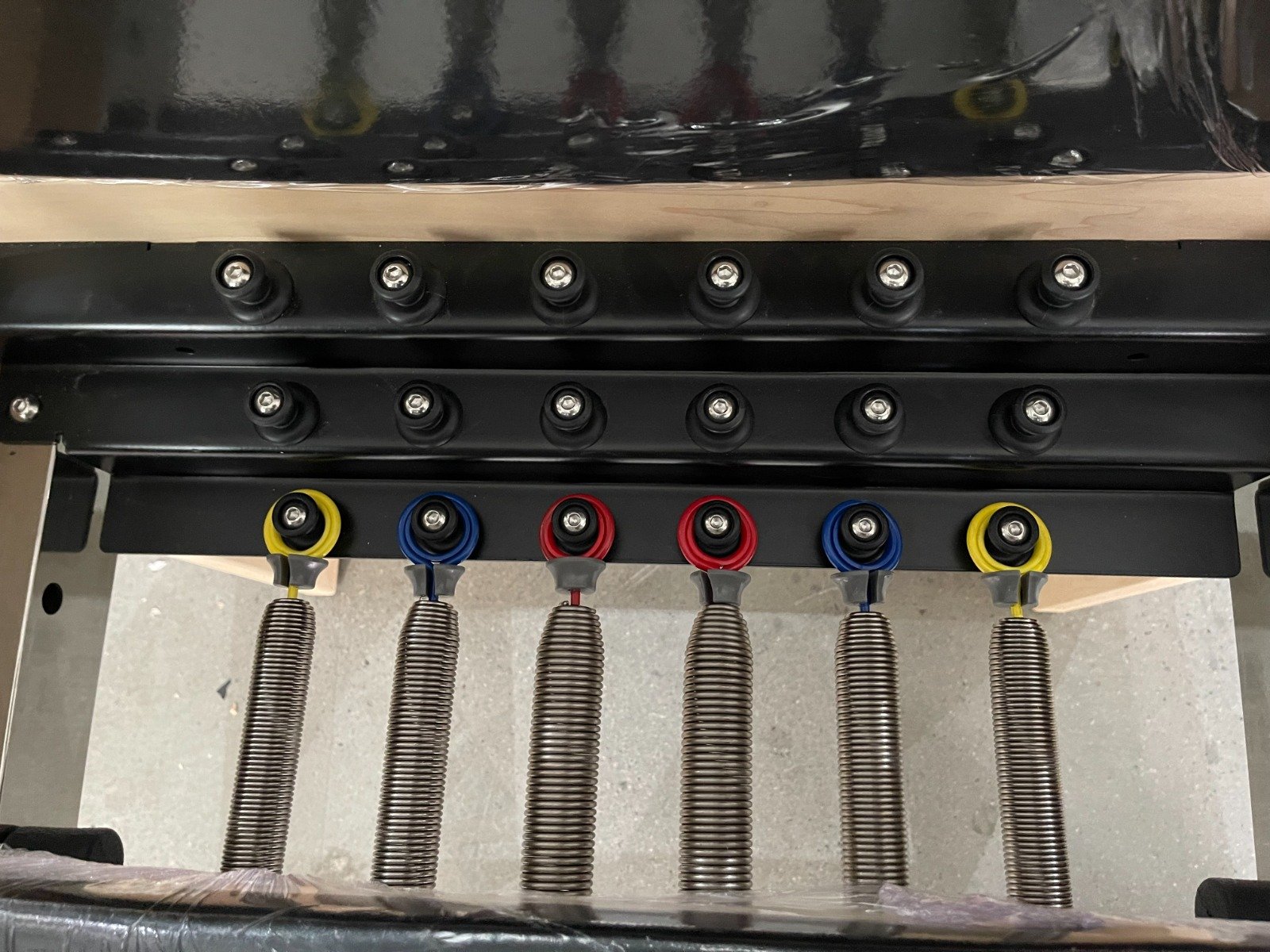
A Pilates spring is a helical extension spring: a coil of hardened steel wire with a hook or loop formed at each end, mounted between a reformer’s frame and its moving carriage. It is the component that converts a sliding platform into a resistance training tool. Every other part of a reformer — the frame, the rails, the carriage, the footbar — exists to support, guide, or anchor this one part, because the spring is the only component that actually generates resistance.
Springs matter disproportionately to their size and cost. A studio can run for years on the same frame and carriage, but springs are consumable — they fatigue, corrode, and eventually fail, and a worn or mismatched spring changes how every single exercise on the machine feels. They are also where the biggest quality gap between cheap and professional equipment shows up, often invisibly, since two springs can look identical and behave very differently depending on the steel, heat treatment, and manufacturing care behind them.
On a Reformer, springs run horizontally between a spring bar (or gear bar) fixed to the frame and hooks on the carriage. The same basic component, in different dimensions, also provides resistance on the Cadillac/Trapeze Table, the Wunda Chair, and some Barrel and Tower attachments. This guide focuses on Reformer springs, since they are the most common and most frequently replaced, but the underlying engineering applies across all Pilates spring applications.
How It Works
A reformer spring is loaded in tension, not compression: pulling the carriage away from the footbar stretches the spring, and the spring’s pull is what returns the carriage and what the practitioner works against. The relationship between stretch and force follows Hooke’s Law — force equals the spring’s rate (its stiffness, usually expressed in kg/mm or lb/in) multiplied by how far it is displaced from its resting length. Within the spring’s elastic range, this relationship is linear: resistance climbs smoothly and predictably as the carriage travels further out, with no sticking point and no sudden change in feel.
This is the mechanical reason a reformer feels different from a weight stack. A weight stack presents a constant load through the whole range of motion — the first inch of a pull feels the same as the last. A spring does the opposite: resistance is lowest at the start of the stretch and highest at full extension, so the working muscles have to keep producing more force as the movement progresses. That progressive loading, not any particular exercise, is what a spring mechanically contributes to Pilates training.
Every load a spring carries eventually funnels through its hooks, which is why the hooks — not the coil — are the highest-stress region of the whole component. Bending wire into a hook creates a sharp change in cross-section right where the load concentrates, so a hook sees higher local stress than the straight sections of coil under the exact same pull. Springs also interact directly with the spring bar (which determines how many springs can be loaded at once and at what angle) and with the carriage hooks, so wear or play in either of those neighboring parts changes how a spring is loaded even if the spring itself is in good condition.
Types
Nearly all Pilates equipment resistance comes from helical extension springs — the type described above. Two other spring families exist in general mechanical engineering (compression springs, loaded by being pushed together, and torsion springs, loaded by twisting), but neither is used to generate a reformer’s working resistance; a compression-type spring would need to push the carriage rather than pull it, which is not how a reformer frame is built.
Within extension springs, manufacturers differentiate resistance grades — commonly three to five per apparatus, often labeled light, medium, and heavy — by changing wire diameter and, to a lesser extent, coil count and coil diameter, while frequently keeping free length constant across a set (see Materials and Engineering below for why). These grades are not a separate “type” of spring mechanically, just different points on the same design space.
A genuinely different type of resistance system does exist: elastic cords (sometimes called bungee cords), used instead of coil springs on some home-market reformers, most notably AeroPilates models. A cord’s resistance curve is softer and more progressive than a coil spring’s — useful for rehabilitation or joint-sensitive users — but cords typically have a shorter service life than steel springs and are more sensitive to heat, UV exposure, and stretching habits. This is a genuine design fork, not a marketing variation: a studio buying commercial equipment is almost always buying coil-spring resistance, while some home reformers use cords specifically as a lower-cost, softer-feel alternative.
Finally, springs used on different apparatus are not interchangeable types in practice even though they share the same engineering principles. Reformer springs, Cadillac/Trapeze Table springs, and Wunda Chair springs are typically built to different free lengths, resistance ranges, and hook styles suited to how each apparatus is loaded and mounted, so a spring correctly sized for one apparatus generally will not be correct for another.
Materials
The material behind the plating is the biggest single factor in how consistent, durable, and corrosion-resistant a spring will be — and it is also the detail a generic listing almost never states clearly.
| Material | Typical Use | Advantages | Limitations |
|---|---|---|---|
| Music wire (high-carbon steel, ASTM A228 / EN 10270-1) | The most common choice across the industry | High tensile strength, very consistent mechanical properties, good fatigue resistance, cost-effective | No inherent corrosion resistance — needs plating; loses strength above roughly 120°C |
| 65Mn spring steel | Widely used in Asian-manufactured equipment | Good strength-to-cost ratio, decent fatigue life when properly heat treated | Corrosion resistance depends entirely on heat treatment and coating quality; more variable between suppliers than music wire |
| Stainless steel (302 / 304 / 17-7PH) | Premium equipment, humid climates, clinical/rehab settings | Excellent corrosion resistance, no plating required, stable in humid studios | Lower tensile strength than music wire at the same wire diameter, so it needs a thicker wire to match the same rate; costs more |
| Chrome silicon / chrome vanadium alloy steel | Heavy-duty and high-cycle applications outside Pilates (automotive, industrial); occasionally used for heavy-resistance springs | Higher fatigue strength and heat resistance than plain carbon steels | Higher cost; rarely necessary at the load levels reformer springs see |
Most commercial reformer springs are music wire or 65Mn, finished with a nickel, zinc, or zinc-chrome plating for corrosion resistance — the combination that gives the best strength-to-cost ratio for a part that gets replaced periodically anyway. Stainless steel shows up more in coastal or humid climates and in clinical settings where hygiene and long-term corrosion resistance outweigh the extra cost. What a listing almost never discloses is which grade was actually used: two visually identical, similarly priced springs can have very different fatigue lives depending on the wire underneath the plating, and this is one of the largest blind spots when comparing generic replacement springs sold online.
Engineering
Design. A spring’s rate is a function of wire diameter, coil (mean) diameter, active coil count, and the shear modulus of the material — not of color or brand. The ratio of coil diameter to wire diameter, called the spring index, typically falls between about 4 and 12 for manufactured springs; indexes outside that range are harder to coil accurately and tend to perform less predictably. Designers set these variables to hit a target rate and a target working length before a single coil is wound.
Manufacturing. Production runs through several stages, and skipping or rushing any of them is exactly how a cheap spring fails early. Wire is first cold-drawn through progressively smaller dies to reach the required diameter, which also work-hardens the steel. It is then cold-coiled around a mandrel, forming the coil body and hooks in the same operation. Heat treatment follows, restoring and stabilizing the mechanical properties disturbed by coiling; a lower-temperature stress-relief bake then removes residual internal stress from the coiling process without softening the wire — this step is one of the most commonly skipped shortcuts in low-cost manufacturing, and its absence shows up later as premature fatigue or a spring that stretches out of shape sooner than it should. Some manufacturers add shot peening, bombarding the surface with fine media to induce a compressive stress layer that measurably extends fatigue life, since fatigue cracks almost always start at the surface. Plating for corrosion resistance and final dimensional inspection close out the process.
Tolerances. No manufacturing process produces two springs that are dimensionally and mechanically identical. Industry tolerance standards (covered in Standards and Regulations below) typically allow around 1–2% variation on physical dimensions and up to about 10% on spring rate for standard-grade springs; tighter, more expensive tolerance classes exist for precision work.
Fatigue. Even loaded within its elastic limit — meaning it always returns to its original shape after each repetition — a spring accumulates microscopic internal damage with every load cycle. This is described by an S-N curve: the higher the stress per cycle, the fewer cycles the spring survives before a fatigue crack initiates and grows to failure; lowering the stress even slightly increases surviving cycles sharply. This is precisely why heavier springs, worked harder and more consistently, often show wear sooner than lighter springs used less frequently.
Elasticity and friction. A spring only obeys Hooke’s Law inside its elastic limit; stretched far enough, it stops returning to its original length, a permanent deformation known as taking a set — one of the clearest signs a spring needs retiring. Friction plays essentially no role in how a spring itself behaves (unlike carriage wheels or rails), but it matters where the spring’s hook rubs against a mounting pin or bar over thousands of cycles, which is a secondary source of surface wear at the hook.
Corrosion. Uncoated carbon steel corrodes readily in the presence of moisture and the mild salinity of sweat. Surface rust degrades plating first, then attacks the base wire; pitting corrosion — small, rough craters — is more damaging than uniform surface rust because it creates stress-concentration points that behave like miniature hooks, accelerating fatigue failure from a location that isn’t even a designed stress point.
How to Tell Quality Apart
Resistance grade and price tell you almost nothing about build quality on their own — two “medium” springs at very different prices can both feel correct on day one. Quality differences show up in details most buyers never check.
- Coil consistency. Lay the spring on a flat surface and check that the coils are evenly spaced along the whole body, with no visibly tighter or looser sections — uneven pitch usually means inconsistent coiling control and an unpredictable rate.
- Hook finish. Look closely at the bend radius where the hook forms. A rough, sharply angular bend, visible tool marks, or a hook that looks hand-finished rather than machine-formed is a red flag, since the hook is already the highest-stress point in the part.
- Plating evenness. Turn the spring under light and check for dull patches, thin spots, or plating that has already started flaking at the hooks straight out of the packaging — inconsistent plating on a new spring is a strong predictor of early corrosion in service.
- Weight and wire diameter versus stated rate. A caliper reading of wire diameter that seems thin for the stated resistance grade, compared against a known-good spring of the same rating, is one of the few checks a buyer can do without lab equipment.
- What to ask a manufacturer. The material grade (music wire, 65Mn, stainless, and which standard it meets), whether the spring is stress-relieved and shot-peened, the actual spring rate rather than just a color or grade name, and the source of the coating (plating type and thickness). A supplier that cannot answer these, or that only offers a color code, is generally selling on price rather than engineering.
- Common buyer mistakes. Assuming a matching color means a matching rate across brands; buying the cheapest available “universal fit” spring without checking free length and hook style; and judging quality by how a spring feels for the first few sessions, before fatigue or plating quality has had time to show.
Wear and Aging
A spring rarely fails without warning; it usually shows a visible decline first. The clearest signs, roughly in order of urgency: a hook that looks bent open, straightened, or cracked at its base — treat this as an immediate replacement, since a hook failure releases stored energy suddenly and without the gradual warning a stretching coil gives; visible free-length growth beyond the original resting length (taking a set), generally a sign to retire the spring once it exceeds a percent or two beyond a matching, unused spring; surface rust that has progressed to pitting rather than staying as light, uniform discoloration; a new creak, grind, or faint ping during a familiar exercise, often the earliest audible warning before any damage is visible; and resistance that feels inconsistent compared to a matching spring of the same rated grade, which usually means one of the pair has fatigued.
As a rough, usage-driven guideline rather than a fixed rule: heavily used commercial springs commonly need replacing every 12–18 months, while lighter home use can often extend a spring’s working life to 2–3 years. These figures vary with usage volume and manufacturing quality, and physical inspection should always take priority over a calendar-based schedule.
Maintenance
Spring maintenance is mostly about what not to do, rather than a long list of active tasks.
- Wipe springs dry after use, particularly in humid studios, since sweat is mildly corrosive and moisture is the main driver of surface rust on carbon steel springs.
- Inspect on a regular schedule — weekly in a busy commercial studio, monthly for lighter home use — using the checks described above.
- Store spare springs dry and separated so they cannot rub against each other or against sharp edges, since even microscopic scratches can become the starting point of a fatigue crack.
- Replace springs in matched sets when one shows wear, rather than pairing a fatigued spring with new ones, since resistance will feel inconsistent between them.
- Do not lubricate springs — oil attracts grit that acts like sandpaper on the coils over time and does nothing to address fatigue, which is the actual cause of most wear.
- Do not apply disinfectant sprays directly to springs; several common studio cleaning chemicals degrade plating faster than they protect it. A dry or barely damp cloth is enough.
- Do not force a spring onto a mounting point it wasn’t sized for, or bend a hook to make it fit — this changes the hook’s geometry and introduces a stress concentration that wasn’t part of the original design.
Compatibility
Springs are not a universal commodity part. Every manufacturer designs its springs around its own frame geometry, spring-bar spacing, hook style, and intended free length, and dimensions vary meaningfully between brands and even between generations of the same brand’s product line.
The parameters that actually determine fit and feel — not just resistance — are free length (hook to hook, unloaded), wire diameter, outside coil diameter, and hook type. Two springs can share a resistance label and still not be interchangeable if any of these differ: a mismatched free length leaves the carriage sitting slack or pre-loaded, a different outside diameter may not clear the spring bar, and a mismatched hook style may not physically attach at all. Color is never a safe basis for cross-brand compatibility — it is a brand-specific convenience label, not a technical specification, and the same color can represent a different resistance level on a different manufacturer’s equipment.
What should never be assumed: that a “medium” or “red” spring from one brand matches another brand’s spring of the same name or color; that free length stays constant across a manufacturer’s own product generations; or that a generic “universal fit” replacement sold online has been checked against your specific machine. The safest approach is matching against the original manufacturer’s part number where possible, or measuring free length, wire diameter, outside diameter, and hook type directly when it is not.
Ready to replace a worn spring? Shop Balanced Body Compatible replacement springs.
One hardware detail worth knowing before swapping springs: Align-Pilates reformers use a patented “Rapid Change (RC) Spring Bar,” which keeps springs attached to the bar while it is repositioned, combining what is normally a separate carriage-stopper step into one motion. Align-Pilates states this reduces the number of actions needed to change resistance compared to a traditional spring bar and separate carriage stopper, which the company says other brands’ systems still require. This is the manufacturer’s own claim, not independently tested by PSP, and does not change spring compatibility itself — it affects how the spring change is performed, not which spring fits.
Related Reading
- The Complete Guide to Pilates Reformer Wheels
- The Complete Guide to Pilates Reformer Ropes
- The Complete Guide to Pilates Reformer Pulleys
- Reformer Wheel Compatibility Finder — find your exact replacement wheel by brand and model
- Can I Use Aftermarket Replacement Springs on My Balanced Body Reformer?
Verification note: Specifications and compatibility information are added progressively and may come from manufacturer documentation, supplier information, or direct measurement. Always confirm the exact machine model before purchasing a replacement part.
Cross-Brand Compatibility & Pricing
Springs carry the sharpest cross-brand incompatibility findings of any component in this guide — and, for two manufacturers, incompatibility within their own product line. The table below is sourced directly from each manufacturer’s own listing.
| Brand | Product | SKU | Price | Configuration | Fits |
|---|---|---|---|---|---|
| Merrithew | Spring Package — Reformer, Traditional | ST05057 | $380.00 USD | 4× 100% + 1× 50% spring | Merrithew Reformers; pre-Dec-2011 units need a Spring Holder upgrade kit (ST05138) |
| Peak Pilates | Metal Line Reformer Spring | 4810-805-026-x | $38–40 USD each | 1 Heavy, 2 Standard, 2 Light (standard config) | Metal Line reformers only — explicitly not compatible with Studio Wood Line |
| Peak Pilates | Studio Wood Line Reformer Spring | 4911-360x-O | $40 USD each, all tensions | Same tension structure as Metal Line | Studio Wood Line reformers (current and discontinued models) only — explicitly not compatible with Metal Line |
| Align-Pilates | Studio Springs Replacement Set | PAPSPRINGSET | £249.95 inc. VAT, set of 5 | 2 Light, 2 Medium, 1 Strong | All commercial reformers (A8-Pro/C8-Pro family) — not stated for the F3 Folding home reformer |
| Balanced Body | Signature Springs | — | €39.00 base / €47.19 PVP (EU distributor, per spring) | 3 Red, 1 Blue, 1 Yellow (standard); varies by model | Model-specific standard configurations (Allegro 2/Nextgen/Stretch, Bravo, CenterLine each differ) |
| Balanced Body | DURO Springs (upgrade line) | — | €48.00 base / €58.08 PVP (EU distributor, per spring) | Same color/slot scheme as Signature | Must not be mixed with Signature Springs on the same Reformer, despite matching configurations — thicker wire, Group-Reformer-class upgrade. See “A Closer Look” below. |
| Gratz | Reformer Springs (Pair) | — | $90.00 USD/pair | — | Classic/Designer Reformers; 2-pair order limit, ~10-day lead time |
| Gratz | Nickel Plated Reformer Springs (Pair) | — | $110.00 USD/pair | — | Same models, recommended for high-humidity environments |
| Elina Pilates | Reformer Bed Springs | ELN 800028 | €30.00 (€36.30 incl. tax), per unit | Yellow/Green/Red = Light/Medium/Strong | Claimed to fit all Elina Pilates equipment (manufacturer claim, not independently verified) |
| Stamina/AeroPilates | (no standalone SKU) | — | — | 4 springs = 8 resistance levels (2 yellow, 2 blue) | Request-only via parts form/phone — not independently purchasable online, unlike every other brand here |
Reading this table correctly: Peak Pilates’ springs split into two mutually exclusive families — Metal Line and Studio Wood Line — with the incompatibility stated symmetrically on both product pages. Balanced Body has the same pattern within one brand: Signature and DURO Springs use identical color-coded configurations but are explicitly not to be mixed on one machine, a wire-gauge/tolerance distinction the manufacturer doesn’t fully disclose. Merrithew Reformers built before December 2011 need a separate Spring Holder upgrade before these springs can be fitted at all. Stamina/AeroPilates is the only brand in this table with no independently purchasable spring SKU at all. None of the springs in this table should be assumed interchangeable across brands, and Balanced Body’s Signature and DURO lines should not be assumed interchangeable with each other — always match against the original manufacturer’s part number.
This same Metal Line / Studio Wood Line split determines wheel compatibility too, not just springs — see the Reformer Wheel Compatibility Finder for the equivalent breakdown on wheels, including a note on where Peak Pilates’ fit and Casa Reformers fit into this grouping.
Disclosed gaps, not silently omitted: Balanced Body’s Signature and DURO spring pricing is not publicly listed by the manufacturer on its US consumer channel (EU distributor pricing is shown above); Elina’s exact steel alloy, Align-Pilates’ F3 home-reformer compatibility, the DURO/Signature mixing-risk mechanism, and Elina’s “fits all Elina equipment” claim are all manufacturer statements not independently verified.
Note on scope: this table answers “which spring do I buy for my machine, and what does it cost” — it does not cover resistance-level equivalence for teachers moving between studios with different brands (e.g., is red heavy or medium?). For that question, StudioGrowth publishes a dedicated spring conversion tool.
Sourced from manufacturer product pages (Merrithew, Peak Pilates, Align-Pilates, Balanced Body, Gratz, Elina Pilates, Stamina/AeroPilates), Company Brain Component Cycle 1, 2026-08-05.
Balanced Body DURO vs. Signature Springs: A Closer Look
Balanced Body sells two spring lines for its own Reformers, Signature and DURO, and explicitly warns against mixing them on the same machine even though they use identical color-coded slots. The table below separates what is manufacturer-stated fact from what is unknown or unverified — DURO is priced higher and warrantied longer, but neither of those facts alone means it is the right choice for every studio.
| Evidence status | Signature Springs | DURO Springs | |
|---|---|---|---|
| Official product page | Positioning | Standard spring, shipped as original equipment across nearly the whole Balanced Body Reformer line | Optional upgrade line, marketed for high-frequency, end-to-end use in Group Reformer classes |
| Official product page | Material | Nickel-plated carbon steel (manufacturer-stated) | Unknown — not disclosed by the manufacturer |
| Manufacturer claim | Engineering distinction | Baseline design (patented, US 7,160,232) | Thicker wire and larger outside coil diameter (manufacturer-stated); manufacturer also claims “the same resistance and feel” as Signature, but no spring-rate figure is published for either line to verify that claim independently |
| Official product page | Dimensions | Regular spring 18.5in / 47cm; Stretch spring (Allegro Stretch only) 24.1in / 61.27cm | Length 18.5in / 47cm (same as Signature’s regular spring). Outer coil diameter varies by color: Yellow 1.6in/4cm, Blue 1.65in/4.2cm, Red 1.45in/3.6cm, Green 1.6in/4cm |
| Official product page | Color / resistance range | Yellow (Very Light), Blue (Light), Red (Medium), Green (Heavy) | Same four colors, same resistance labels (manufacturer-stated) |
| Official product page | Standard configuration | Model-specific — e.g. 3 Red/1 Blue/1 Yellow on Allegro 2, Allegro Nextgen, Bravo; varies by model | Model-specific, 6 models directly documented: Allegro (3R/1B/1Y), Allegro Nextgen (3R/1B/1Y), Allegro 2 (3R/1B/1Y), Bravo (3R/1B/1G), Rialto (3R/1B/1G), Studio (3R/1B/1G) |
| Official product page | Hardware dependency | — | Allegro, Allegro Nextgen, and Rialto Reformers each require a different Spring Support component to fit DURO Springs than their standard hardware — stated on the manufacturer’s own configuration list for exactly these 3 of 6 models (Allegro 2, Bravo, and Studio need none) |
| Distributor claim | Price (EU distributor, per spring, all colors) | €39.00 base / €47.19 PVP | €48.00 base / €58.08 PVP (+€9.00 base, +23.1%) |
| Unresolved | Price (US) | Not publicly listed — “contact your local representative” | Discrepancy on Balanced Body’s own page: visible page text says “contact your local representative for pricing,” but the same page’s meta-description tag states “$40 each or save with 5-pack.” Both recorded rather than picking one. |
| Official product page | Bulk discount | Not stated | Save 20% on orders of 5 or more |
| Official product page | Warranty (≤4 Reformers) | 2 years from invoice date, or 3,000 hours of use | 3 years from invoice date, or 3,000 hours of use |
| Official product page | Warranty (5+ Reformers, group setting) | 1 year | 2 years |
| Official product page | Sold as | Individually, no fixed multi-spring kit price; all sales final | Individually; all sales final (manufacturer states this explicitly for DURO too) |
| Official product page | Confirmed compatible models | 11 models: Reformer (generic), Allegro 2, Rialto, Studio, Bravo, Allegro Nextgen, Anniversary Allegro 2, Metro IQ, Reformer Trapeze Combination, Ron Fletcher Reformer | 6 models directly documented on DURO’s own product page: Allegro, Allegro Nextgen, Allegro 2, Bravo, Rialto, Studio |
| Official product page | Mixing restriction | — | Must not be mixed with Signature Springs on the same Reformer, per Balanced Body’s own product materials, despite identical color-coded slots |
Why the warranty is longer but that doesn’t mean “always buy DURO.” DURO’s warranty structure is uniformly one year longer than Signature’s at both usage tiers — a real, verifiable difference sourced directly from each product’s own manufacturer page. That is consistent with DURO being positioned and priced as the higher-durability option for high-frequency Group Reformer use. It is not evidence that DURO is the better choice in every setting: Signature is the lower-cost, standard-equipment spring already fitted to most of the Balanced Body Reformer line, and no independent, third-party fatigue-life or failure-rate data exists for either line — the warranty terms are manufacturer commercial policy, not independently measured durability data, and the “same resistance and feel” claim is the manufacturer’s own marketing language, not a verified spring-rate match. A studio running one or two Reformers at moderate class volume has no documented reason here to pay the 23% DURO premium (plus, on 3 of the 6 documented models, a hardware swap); a Group-Reformer studio running high class volume is who Balanced Body itself markets DURO to.
On the mixing warning. Balanced Body states DURO and Signature must not be mixed on the same Reformer, but does not publish the technical reason. We have not independently confirmed a wire-gauge or tolerance mismatch as the cause — that would be our own inference, not a manufacturer statement, so it is not asserted here. Do not mix the two lines on one machine unless Balanced Body explicitly confirms it is safe to do so.
Sourced from Balanced Body’s own Signature Springs and DURO Springs product pages, and the Tecno Sport Condition, S.L. 2026 EU distributor tariff. Company Brain Cycle 29, 2026-08-06.
Merrithew / STOTT PILATES Reformer Springs: The Full Picture
Merrithew’s printed equipment catalog says almost nothing about its own springs — no rate, no dimensions, just a percentage label. The manufacturer’s own website tells a different story: Merrithew runs a public “Spring Center” that publishes initial tension, spring rate, free length and coil diameter for every Reformer spring it sells, plus an owner’s manual with a maximum-stretch and maximum-force table for each one. The specifications below come from those primary sources, not the catalog.
| Evidence status | Color (O-ring) | SKU | Initial tension | Spring rate | Free length | Coil OD | Max stretch | Max force |
|---|---|---|---|---|---|---|---|---|
| Official product page | White (25%) | ST05054 | 2.25–3.25 lb (1.0–1.5 kg) | 0.311 lb/in ±5% | 19.5in / 49.5cm | 1.5in / 4cm | 95in | 26 lbf |
| Official product page (package only — no individual SKU) | Blue (50%) | — | 3.0–4.0 lb (1.4–1.8 kg) | 0.625 lb/in ±5% | 19.5in / 49.5cm | 1.5in / 4cm | 74in | 36 lbf |
| Official product page (package only — no individual SKU) | Red (100%) | — | 6.0–7.5 lb (2.7–3.4 kg) | 1.25 lb/in ±5% | 19.5in / 49.5cm | 1.5in / 4cm | 58in | 53 lbf |
| Official product page | Black (125%) | ST05097 | 7.0–11.0 lb (3.2–5.0 kg) | 1.56 lb/in ±5% | 19.5in / 49.5cm | 1.5in / 4cm | 57in | 59 lbf† |
† Merrithew’s own published rate and tension figures for the 125% spring predict a max force around 10–13% higher than the 59 lbf the owner’s manual states. The 25%, 50% and 100% rows all reconcile with their own rate/tension figures; the 125% row does not. Recorded as published, not corrected — treat the 125% max-force figure as unverified until measured directly.
The 50% and 100% springs — the two used in the highest quantity on every Merrithew Reformer — are not sold individually. A studio that needs to replace two worn 100% springs currently has to buy the full five-spring package.
Only the 25% and 125% are sold as standalone springs; only the 5-spring packages contain a 50% or 100%.
What the percentage label actually measures
Merrithew’s 25/50/100/125% labels track spring rate almost exactly — 0.311, 0.625, 1.25 and 1.56 lb/in scale to within half a percent of a straight 25/50/100/125% line. But rate is not the same as felt resistance, because initial tension does not scale the same way. At a real working extension, the gap is significant:
| Extension from free length | 25% spring force | 100% spring force | 25% as % of 100% |
|---|---|---|---|
| 5 in | ≈4.3 lbf | ≈13.0 lbf | ≈33% |
| 20 in | ≈9.0 lbf | ≈31.8 lbf | ≈28% |
A “25%” spring delivers roughly 28–33% of the 100% spring’s actual pull at typical carriage travel, not 25%. The label is a rate ratio, not a force ratio — one more reason color and percentage labels should never be read as an absolute resistance value across brands, or even taken too literally within one brand’s own range.
Cadillac, Vertical Frame, Wall Unit, Spring Wall and Stability Chair
Merrithew’s Cadillac/Trapeze Table, Vertical Frame (Tower Trainer), Wall Unit and Spring Wall share one family of five spring types. The Split-Pedal Stability Chair uses two springs of its own — sold under different names, but published with specifications identical to two of the shared family.
| Spring | Color | SKU (pair) | Initial tension | Spring rate | Length | Coil OD | Used on |
|---|---|---|---|---|---|---|---|
| Leg · Enhanced | Green | ST05124 | 3.0–4.0 lb (1.4–1.8 kg) | 0.625 lb/in | 22in / 55.9cm | 1.2in / 3cm | Cadillac, Vertical Frame, Wall Unit, Spring Wall |
| Light Arm | Yellow | ST05125 | 2.2–3.2 lb (1.0–1.5 kg) | 0.378 lb/in | 19in / 48.3cm | 1.1in / 2.8cm | Cadillac, Vertical Frame, Wall Unit |
| Roll-Down | Black | ST05127 | 2.9–3.9 lb (1.3–1.8 kg) | 0.495 lb/in | 19in / 48.3cm | 1.2in / 3cm | Cadillac, Vertical Frame, Wall Unit, Spring Wall |
| Push-Thru | Blue | ST05126 | 5.5–7.5 lb (2.5–3.4 kg) | 1.157 lb/in | 18in / 45.7cm | 1.1in / 2.8cm | Cadillac, Vertical Frame, Wall Unit |
| Trapeze | Red | ST05128 | 14.75 ±1.5 lb (6.7 ±.7 kg) | 3.888 lb/in | 18in / 45.7cm | 1.2in / 3cm | Cadillac only |
| Chair · Light | Blue | ST05130 | 5.5–7.5 lb (2.5–3.4 kg) | 1.157 lb/in | 18in / 45.7cm | 1.1in / 2.8cm | Split-Pedal Stability Chair |
| Chair · Heavy | Red | ST05129 | 14.75 ±1.5 lb (6.7 ±.7 kg) | 3.888 lb/in | 18in / 45.7cm | 1.2in / 3cm | Split-Pedal Stability Chair |
Note: Chair · Light shares identical published length, coil diameter, tension and rate with Push-Thru; Chair · Heavy shares identical published specifications with Trapeze. Merrithew does not state these are the same physical spring under two names — this is an observation from the published data, not a manufacturer claim, and it is not a basis for treating the SKUs as interchangeable.
The spring-ball attachment — and the December 2011 cutoff
Merrithew’s own spring pages describe an “innovative spring ball attachment” with “no exposed hooks” — a captive ball fitting rather than the open hook most other brands use. This is the actual mechanical reason Merrithew springs are not interchangeable with other manufacturers’ springs, regardless of matching rate or length.
It also creates a hard compatibility line within Merrithew’s own range: Reformers built before December 1, 2011 used a different spring holder and cannot accept current springs without a Spring Holder Upgrade Kit (ST05100 for At Home/Club/Group SPX machines, ST05138 for SPX Max/V2 Max/Rehab V2 Max). Anyone buying replacement springs for an older Merrithew Reformer should check the holder before ordering springs.
Replacement interval
Merrithew’s Reformer owner’s manual (document PM-P00179-16, JAN23) instructs replacing all springs every 24 months and all spring clips every 12 months, and states that failure to do so on schedule may void the warranty — springs and clips are explicitly excluded from Merrithew’s Limited Lifetime Warranty as wear items. The same manual calls for a weekly visual inspection of every spring for wear and damage.
Sourced from Merrithew’s own Spring Center product listings (individual spring and spring-package pages) and Reformer Owner’s Manual, document PM-P00179-16, JAN23. Verified 2026-08-14.
Reformer Spring Compatibility Finder
The tables above compare spring specifications side by side. But most buyers arrive with a narrower question: what do I actually order for the reformer sitting in my studio right now? The interactive tool below answers that directly. Select your reformer’s manufacturer and line, and it returns the correct replacement spring or spring set for that exact model — SKU or part reference where one is published, price, spring-set contents, and any brand-specific compatibility warning (such as Balanced Body’s DURO-vs-Signature no-mix rule or Peak Pilates’ Metal Line/Studio Wood Line split covered above). Every result traces back to a manufacturer source; where we have not yet independently verified a price or SKU, the tool says so instead of guessing.
Wondering whether a non-OEM spring is a safe choice at all, before you even get to the tool below? See Can I Use Aftermarket Replacement Springs on My Balanced Body Reformer?
Find your replacement spring
Select your reformer’s manufacturer and line below to see the correct replacement spring or spring set, its color-resistance mapping, price, and any compatibility warnings. This tool answers a different question than a resistance-conversion chart (“what does Brand A’s red match on Brand B”) — it tells you exactly what to order for your specific machine. Every result is sourced directly from manufacturer product pages; where we haven’t yet verified exact pricing or SKU data, we say so rather than guess.
Why springs aren’t interchangeable across brands — or even within one brand’s own range
No two manufacturers use the same color-to-resistance code. On a Balanced Body or Merrithew Reformer, red is a medium/100% spring; on other brands the same red can mean something heavier. Peak Pilates goes further and splits its own catalog in two: Metal Line springs and Studio Wood Line springs are explicitly, mutually incompatible, despite sharing the same 19.5in length and color-coding scheme. Balanced Body’s own upgrade line, DURO Springs, uses thicker wire and a larger coil diameter than its standard Signature Springs and — despite fitting the same configuration slots — the manufacturer explicitly warns against mixing the two on one machine.
Reformers built before a manufacturer’s own hardware revision can also need an upgraded part before new springs are safe to install: Merrithew states that any Reformer made before December 1, 2011 needs an upgraded Spring Holder (sold separately) before its current Traditional spring package can be fitted correctly.
Replacement cadence also varies: Peak Pilates states a 2-year interval (or immediately if coil separation is visible); Balanced Body and Merrithew warranty springs for 2–3 years depending on the line and studio usage volume; several manufacturers (Elina, BASI, Gratz) don’t publish a calendar interval at all — inspect for visible wear as the trigger instead.
Common ordering mistake: matching springs by color alone. The same color code means a different resistance level on different brands, and — on Peak Pilates specifically — the same color code on two different product lines (Metal Line vs. Studio Wood Line) is not the same physical spring at all. Confirm your reformer’s manufacturer and product line before ordering by color.
How to Measure Your Spring for an Exact Match
Can’t find your exact manufacturer or line in the finder above — or want to double-check a replacement before you order? Use the same measurement protocol reformer manufacturers and component engineers use to verify a candidate spring is a genuine engineering match, not just something that “looks about right.” A spring can match your original in overall length and still deliver noticeably different resistance if the wire diameter or coil count is off.
What you’ll need: a tape measure or ruler, a caliper (for wire diameter — a cheap digital one is accurate enough), and a coin or ruler to include in photos for scale.
- Work on one spring at a time. Remove and label a single spring per color/resistance level before moving to the next — never pull all of them at once, or you’ll lose track of which spring came from which position.
- Measure five dimensions: total free length (fully relaxed, end to end), body length (the coiled section only, excluding the terminals), terminal/hook length, outside diameter of the coil, and wire diameter.
- Count the active coils and note which way the terminal (hook or loop) faces relative to the coil — some reformers are sensitive to terminal orientation for correct carriage travel.
- Photograph the spring’s side profile, both terminals, and any visible wear or markings, with a coin or ruler in frame for scale. This is useful both for your own records and if you need to send photos to a manufacturer or supplier to confirm a match.
- Compare every dimension against the replacement candidate — not just overall length. If two of the five measurements differ by more than a small margin, treat it as a different spring, not a substitute.
Still not sure after measuring? Cross-check your manufacturer and line in the finder above, or contact the manufacturer directly with your photos and measurements — most of the manufacturers covered on this page will identify a spring from clear photos and dimensions even without a model number.
This measurement protocol is adapted from the same methodology Pilates Spare Parts uses internally to validate whether a candidate replacement spring is an authentic match before recommending it — applied here for readers checking their own reformer.
Standards and Regulations
There is no international standard written specifically for Pilates or reformer springs. What exists are general mechanical-engineering standards that apply to spring wire and spring manufacturing broadly, and that reputable spring makers — including those supplying the Pilates industry — commonly reference:
- ASTM A228 / EN 10270-1 — specifications for cold-drawn, high-carbon steel “music wire,” the base material most reformer springs are made from; the two standards are broadly equivalent, alongside DIN 17223 and JIS G3522.
- DIN 2097 (now largely superseded by EN 15800) — quality and tolerance specifications for cold-coiled tension (extension) springs specifically, defining tolerance grades for coil diameter, free length, and load. (Note: DIN 2095 covers compression springs, a related but different standard that is sometimes cited incorrectly for extension-spring products.)
- EN 13906-2 — the design-calculation standard for cylindrical helical extension springs, covering how spring rate, stress, and fatigue life are calculated from a spring’s geometry and material.
General fitness-equipment safety standards exist as well, but they do not appear to govern spring-based Pilates equipment specifically — for example, ASTM F2216 covers selectorized (weight-stack) strength equipment, a different resistance mechanism entirely. We have not identified a fitness-equipment standard that specifically addresses spring-based reformers, and we state that gap plainly rather than implying one exists. If a reader is aware of a Pilates- or reformer-specific standard we have missed, we would treat that as a correction worth verifying and incorporating.
Frequently Asked Questions
What type of spring is used in a Pilates reformer?
A helical extension (tension) spring — a coil of steel wire with hooks at each end, designed to pull back when stretched. Compression and torsion springs, the other two main spring families, are not used to generate a reformer’s working resistance.
What material are Pilates springs made from?
Most commercial reformer springs use music wire (high-carbon steel per ASTM A228 / EN 10270-1) or 65Mn spring steel, typically plated for corrosion resistance. Stainless steel (302, 304, or 17-7PH) is used in some premium or humidity-prone applications.
Does spring color tell me the resistance level?
Only within one manufacturer’s own system. Color coding is brand-specific, not standardized industry-wide, so the same color can mean a different resistance level on a different brand’s equipment.
How often should reformer springs be replaced?
As a rough guideline, heavily used commercial springs typically need replacing every 12–18 months, and lighter home use can extend that to 2–3 years. Physical inspection should always take priority over a fixed calendar schedule.
Why do heavier springs seem to wear out faster than lighter ones?
Fatigue life drops sharply as stress per cycle increases — a relationship spring engineers describe with an S-N curve. A heavily loaded spring accumulates internal fatigue damage faster per repetition than a lightly loaded one.
Can I mix spring brands on the same reformer?
Only after confirming free length, wire diameter, outside diameter, and hook type match your machine — matching by color or general resistance description alone is one of the most common compatibility mistakes.
Is stainless steel better than regular carbon steel for Pilates springs?
It is more corrosion-resistant and needs no plating, which matters in humid climates or heavily sanitized settings. It generally has lower tensile strength than music wire at the same wire diameter, so it needs to be slightly thicker to match the same resistance.
What is the most common point of failure on a Pilates spring?
The hooks, not the coiled body. Hooks concentrate stress every time the spring is loaded, which is why hook condition deserves more attention during inspection than the coil itself.
Is it safe to keep using a spring with light surface rust?
Light, uniform surface rust is a warning sign to monitor, not necessarily an immediate emergency. Once it develops into pitting — small, rough craters — the wire itself is compromised and the spring should be retired.
Can a worn or corroded spring be repaired instead of replaced?
No. Once a spring shows fatigue damage, corrosion pitting, or hook deformation, its mechanical properties have changed permanently, and there is no reliable way to restore it to its original specification.
Is there an official standard governing Pilates spring safety or quality?
No Pilates- or reformer-specific standard exists. Spring wire and manufacturing generally follow general mechanical standards such as ASTM A228 / EN 10270-1 (wire) and EN 15800 / DIN 2097 (tension spring tolerances), but these are general engineering standards, not Pilates industry regulations.
What’s the difference between reformer springs and Cadillac or Wunda Chair springs?
All are extension springs following the same engineering principles, but they are typically built to different free lengths, resistance ranges, and hook styles to match how each apparatus is used, and they are generally not interchangeable between apparatus types.
Why does a manufacturer’s spring cost more than a generic replacement with the same color label?
Price differences usually trace back to steps that don’t show up in a listing: material grade, stress relieving, shot peening, plating quality, and factory-level dimensional inspection. Two springs with the same color label can differ in all of these without a buyer being able to tell from a photo.
What’s the difference between Balanced Body Signature and DURO Springs?
DURO is Balanced Body’s optional upgrade spring line — priced about 23% higher and warrantied one year longer than Signature at every usage tier — intended for high-frequency Group Reformer classes. It has a measurably larger outer coil diameter than Signature at the same overall length (varies by color). Balanced Body claims DURO delivers “the same resistance and feel” as Signature despite this, but does not publish a spring-rate figure to verify that claim independently. The two springs must not be mixed on the same Reformer despite sharing the same four-color slot scheme, and 3 of the 6 models DURO is documented for (Allegro, Allegro Nextgen, Rialto) need a different Spring Support component to fit it.
Conclusion
A Pilates spring looks simple — a coil of wire with a hook at each end — but everything about how a reformer performs, and how safely it performs, is packed into that coil. It is a helical extension spring, governed by Hooke’s Law within its elastic limit, made from music wire, 65Mn, or stainless steel depending on the application, and built through wire drawing, coiling, heat treatment, and often stress relief and shot peening — steps whose presence or absence is exactly what separates a spring that lasts years from one that fails early. Its resistance grade is defined by spring rate, not color; its dimensions, not its label, determine whether a replacement will actually fit; and its failure mode is almost always fatigue at the hooks, preceded by visible warning signs rather than sudden, unannounced breakage.
A reader finishing this guide should be able to describe a reformer spring in the terms a manufacturer or technician actually uses — material grade, wire diameter, free length, hook type, spring rate — rather than by color alone, know what separates a well-made spring from a cheap one, recognize the warning signs of wear before failure, and understand why compatibility has to be checked by measurement, not assumption. That is the foundation the rest of this component library builds on.
Related Reading
Published guides are linked directly. The rest are planned articles that will be linked here as they go live.
- Pilates Spring Dimensions: The Complete Measurement Guide (published)
- How to Measure a Pilates Spring: Step-by-Step
- Pilates Spring Colors Explained, Brand by Brand
- Music Wire vs. 65Mn vs. Stainless Steel: Choosing a Spring Material
- Reformer vs. Cadillac vs. Wunda Chair Springs: What’s Different
- Coil Springs vs. Bungee Cords: Comparing Reformer Resistance Systems
- How to Inspect a Pilates Spring in Five Minutes (Printable Checklist)
- Pilates Spring Maintenance: A Studio’s Weekly Routine
- Spring Fatigue Explained: Why Springs Fail Without Breaking First
- What Is Spring Rate, and Why It Matters More Than Color
- Understanding Hook Types: Machine Hook vs. Closed Loop vs. Side Hook
- Reformer Spring Safety: What to Do When a Spring Fails
- How Many Springs Does a Reformer Need, and Why
- Balanced Body Springs: Specifications and Replacement
- Merrithew / STOTT PILATES Reformer Springs: Full Specifications (covered above)
- Gratz Springs: Specifications and Replacement
- Peak Pilates Springs: Specifications and Replacement
- Elina Pilates Springs: Specifications and Replacement
- Bonpilates Springs: Specifications and Replacement
- Reformer Carriage Wheels: Component Overview (published)
- Reformer Pulleys: Component Overview (published)
- Reformer Ropes: Component Overview (published)
- Reformer Straps and Handles: Component Overview
This guide combines general spring engineering — materials science, manufacturing processes, fatigue theory, and published industry standards — with Pilates industry practice and hands-on studio maintenance experience. Manufacturer-specific figures such as exact spring rates and dimensions vary by brand and model and are not claimed here as universal; see our brand-specific guides for exact specifications as they are published. Where a claim could not be independently verified, it is presented as industry practice or an unverified claim, not as established fact. Last verified: July 2026. Merrithew Reformer, Cadillac, Vertical Frame, Wall Unit, Spring Wall and Stability Chair spring specifications added and verified against Merrithew\u2019s own Spring Center and Reformer Owner\u2019s Manual (PM-P00179-16, JAN23) on 2026-08-14.