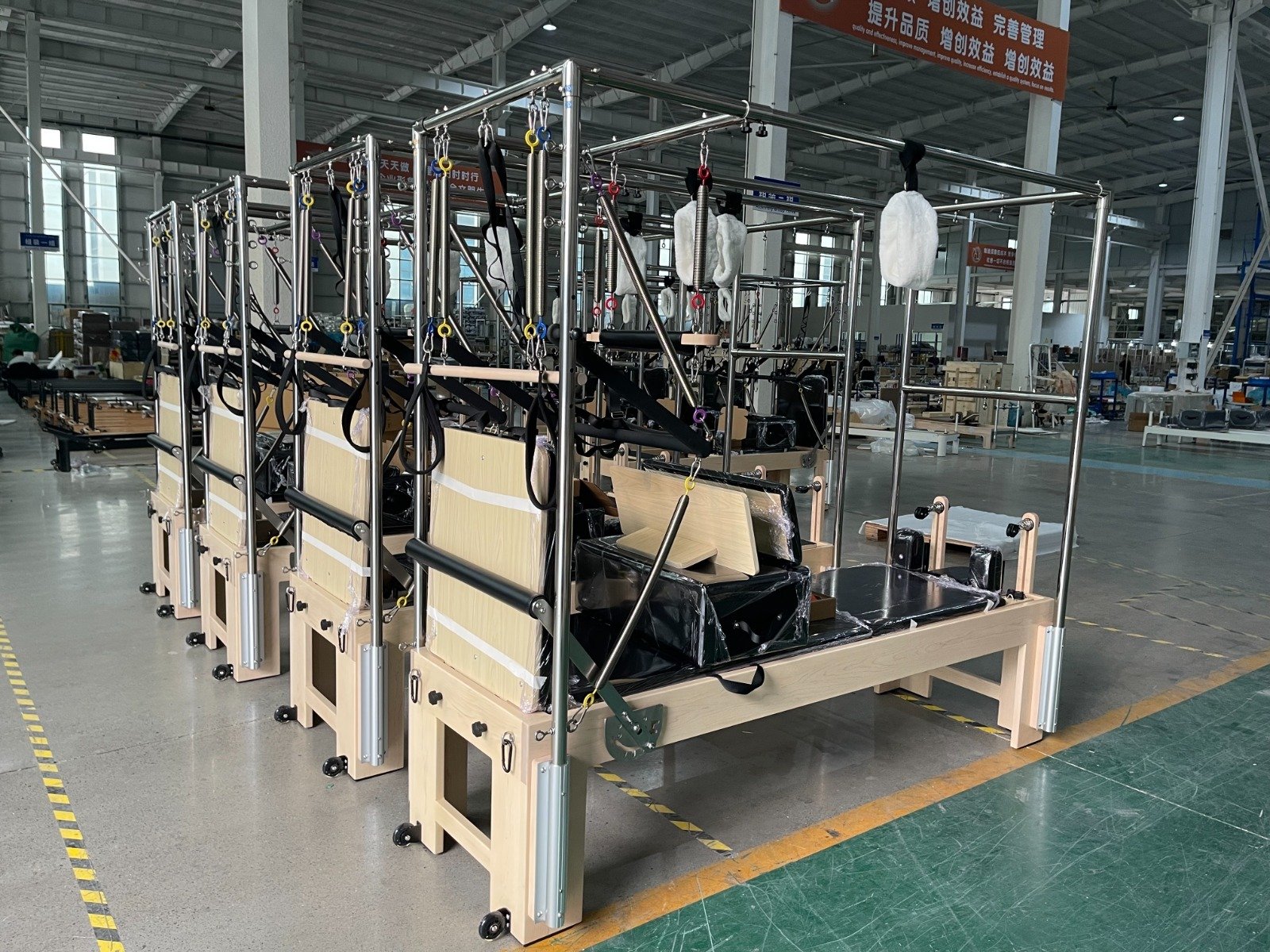
Over the last several years, a growing number of Pilates studios, distributors, and equipment resellers have started sourcing machinery directly from Chinese manufacturers instead of buying through a national distributor. The motivation is almost always the same: lower cost, more flexibility, and direct access to a factory instead of paying a distributor’s margin on top of the price.
This strategy can work extremely well — but only when the buyer genuinely understands the entire process, not just the unit price on a quotation. The biggest problems with direct China sourcing rarely appear at the moment of purchase. The sample looks good, the price is right, the factory seems responsive, and the order goes ahead. The real problems tend to surface months later: when a part wears out and the factory that made the machine is unreachable, when a shipment arrives with a fitting that doesn’t quite match the sample, or when a studio realizes it has no idea how to identify the exact spring or wheel it needs to reorder.
This guide is not an argument against buying from China. China manufactures a large share of the world’s Pilates equipment, including for many well-known international brands, and there are excellent, serious manufacturers producing equipment to a very high standard. The goal of this article is narrower and more practical: to explain, in technical and unemotional terms, what actually happens during a direct import, where the real risks sit, and what a buyer can do to reduce them.
Why Buy Directly From China?
It’s worth being explicit about the real advantages, because they are real, and pretending otherwise would be dishonest.
- Lower cost. Removing a distributor’s margin and buying at, or close to, factory price is usually the single biggest driver, and the savings can be substantial on larger orders.
- Customization. Frame dimensions, upholstery color, footbar shape, or spring configuration can often be adjusted in ways a pre-built distributor catalog doesn’t allow.
- OEM manufacturing. Many factories will produce equipment to a buyer’s own specification sheet, not just their standard catalog model.
- Private label. A studio chain or distributor can put its own brand on the equipment, which matters for anyone building a business around their own identity rather than reselling someone else’s brand.
- Variety. Direct access to the manufacturing market exposes a buyer to a far wider range of designs, price points, and configurations than a single national distributor typically carries.
- Direct access to the manufacturer. Technical questions, custom requests, and negotiation can happen directly with the people who actually build the machine, without a layer of intermediaries.
None of these advantages disappear because the process is more demanding. They just have to be weighed against the additional work, and against risks that a distributor would normally have already absorbed on the buyer’s behalf.
How to Choose a Manufacturer
Vetting a manufacturer properly takes time, and most of it happens before any money changes hands. A few areas are worth investigating specifically:
- Years in operation. A company’s registration date and trading history can usually be checked through business registries or B2B sourcing platforms, and give a basic sense of stability.
- Whether they own the factory. Some suppliers present themselves as manufacturers but actually subcontract production to a third factory. This isn’t necessarily disqualifying, but it changes who is actually responsible for quality control, and it’s worth knowing.
- Certifications. Ask what certifications apply to the specific product, not just the company in general, and ask to see the actual certificate rather than a logo on a website.
- References. Ask for contact details of past buyers, ideally in a different country than your own, and actually reach out to them.
- Real photographs, not catalog renders. Ask for recent photos of the actual production floor and finished units, not marketing images that could belong to any factory.
- Video. A short video call or a walk-through video of the workshop is far harder to fake convincingly than a set of photos, and is one of the highest-value, lowest-cost verification steps available.
- Previous clients. Ask specifically whether they’ve exported reformers or similar equipment before, to which markets, and in what volumes.
- Inspections. Third-party inspection companies can visit a factory on your behalf before you ever commit to a deposit, and their reports are a useful, relatively inexpensive way to confirm a factory is what it claims to be.
- Communication quality. How precisely they answer technical questions during the sales process is a reasonable early signal of how they’ll communicate once you’re a paying customer with a problem.
Manufacturer vs. Trading Company
One of the most common misunderstandings in China sourcing is assuming you’re talking directly to a factory when you’re actually talking to a trading company — an intermediary that sources from one or several factories, adds a margin, and manages the sales relationship. This isn’t inherently a problem: some trading companies are excellent, offer useful language and logistics support, and work with reliable factories. The issue is not knowing which one you’re dealing with, because it changes how you should think about quality control, pricing, and who is actually accountable when something goes wrong.
A few practical signals can help tell the two apart, though none of them is fully conclusive on its own:
- A genuine factory can usually answer detailed production questions — welding process, powder coating line, specific material suppliers — quickly and specifically. A trading company often needs to check with the factory first, which introduces delay and occasional inconsistency in the answers.
- Ask directly whether they manufacture in-house or work with a factory, and ask for the factory’s name and address. A trustworthy supplier of either type will generally answer this honestly if asked plainly.
- A video call that includes a walk-through of the actual production floor, ideally with production of your specific product visible, is difficult for a pure trading company to arrange convincingly.
- Company registration details, when available, sometimes indicate the registered business scope (manufacturing vs. trading), though this varies by platform and isn’t always reliable or fully up to date.
Neither option is automatically the wrong choice. What matters is knowing which one you’re working with, and pricing and evaluating the relationship accordingly.
Why a Sample Never Guarantees the Full Order
A sample is made under conditions that don’t necessarily reflect a full production run. It’s often built by the factory’s most experienced staff, with extra care, sometimes using a different batch of materials than what will be used at scale. None of this is necessarily dishonest — it’s simply a different production context than a full order running through the normal line, on a normal schedule, with normal staffing.
This is why sample approval should be treated as a formal step, not a formality. What should be documented at this stage:
- Photographs of every visible surface, joint, weld, and finish, in good lighting, from multiple angles, including close-ups of any area you consider critical (footbar attachment, carriage wheels, spring hooks, upholstery seams).
- Video of the sample actually being used — the carriage rolling, the springs engaging, the footbar folding — not just static shots.
- Exact measurements of critical dimensions, recorded in writing, not just visually approved.
- A written specification sheet covering materials, finishes, dimensions, and any customization, signed off by both sides as the reference for the full order — not just an approval message in a chat window.
Formal sample approval matters for a very practical reason: if the bulk order doesn’t match the sample, having a documented, mutually agreed reference point is what gives a buyer any real leverage to request a correction.
Incoterms
Incoterms are standardized international trade terms, published by the International Chamber of Commerce, that define exactly where the seller’s responsibility ends and the buyer’s begins: who arranges and pays for transport, who handles export and import customs clearance, who insures the cargo, and the precise point at which risk of loss or damage passes from seller to buyer. Four terms come up constantly in Pilates equipment sourcing.
| Term | Seller’s responsibility ends | Buyer arranges | Typical risk for the buyer |
|---|---|---|---|
| EXW (Ex Works) | Goods made available at the factory door | Export clearance, all freight, insurance, import clearance | Maximum buyer responsibility; export clearance can be a practical obstacle if the buyer has no local presence in China |
| FOB (Free On Board) | Goods loaded onto the vessel at the origin port | Ocean freight, insurance, import clearance | Buyer needs a freight forwarder from the origin port onward; risk transfers at loading, before the goods even leave China |
| CIF (Cost, Insurance and Freight) | Seller pays freight and minimum insurance to the destination port | Import clearance and delivery from the destination port | Risk still transfers at loading in China, the same point as FOB — sellers pay to get the goods to destination, but the buyer bears the risk for the entire voyage, a distinction that surprises many first-time buyers |
| DDP (Delivered Duty Paid) | Goods delivered to the buyer’s named destination, duties and taxes paid | Nothing — the seller handles the full chain | Simplest for the buyer, but the buyer loses visibility and control over declared customs values and the choice of carrier, which can matter if a dispute arises |
The most common mistake buyers make with Incoterms isn’t choosing the wrong one — it’s not realizing that CIF and DDP shift cost to the seller without necessarily shifting risk or control in the way they assume. A buyer who has never imported before and wants the least operational complexity will usually find DDP the most manageable starting point, even though it tends to carry a higher unit cost, because it converts a long list of unfamiliar logistics decisions into a single, quoted price from the seller.
International Shipping
Pilates equipment is bulky and heavy relative to its value, which makes sea freight the default choice for full machine orders; air freight is generally reserved for spare parts or urgent small shipments, where speed matters more than the higher cost per kilogram.
For smaller orders that don’t fill a full container, cargo is typically consolidated with other buyers’ shipments (LCL, or less-than-container-load), which is more affordable per unit but adds handling steps — and each additional handling step is an additional opportunity for damage. A full container (FCL) costs more upfront but is handled as a single sealed unit from origin to destination, which generally reduces handling-related damage.
Cargo insurance is worth arranging independently of whichever Incoterm is used, and worth reading carefully rather than assuming it covers everything: policies vary in what they cover, and a minimum-coverage policy (as required under CIF, for example) may not fully cover the replacement cost of a damaged reformer.
Packaging deserves real attention before shipment, not just at the point of complaint. Ask specifically how the equipment will be packed — wooden crating, corner protection, how the carriage and springs are secured during transit — and request photos of the actual packaging used for your order, since transit damage is one of the more common and more preventable sources of dispute after a shipment arrives.
Customs
This section is a general technical overview, not legal or tax advice; customs rules, duty rates, and VAT treatment vary by country and change over time, and a licensed customs broker or accountant should always be consulted for a specific import.
In broad terms, importing equipment typically involves import duties (a percentage of the declared customs value, which varies by country and product classification), import VAT or an equivalent sales tax in most jurisdictions, and customs clearance formalities that require specific documentation — commercial invoice, packing list, bill of lading, and often a certificate of origin. Missing or inconsistent documentation is one of the most common causes of unexpected delay and cost at the border, more often than the duty rate itself.
Buyers are frequently surprised by costs that weren’t clearly itemized in the original quotation: destination port handling fees, customs broker fees, bonded warehouse storage if clearance is delayed, and last-mile delivery from the port to the studio. Asking a freight forwarder or customs broker for a full landed-cost estimate before ordering — not just the factory price and freight — gives a far more realistic picture of the total cost than the initial quotation alone.
Communication
Communication problems are one of the most common sources of friction in direct sourcing, and they rarely come from a single dramatic failure — they accumulate from smaller, ordinary causes.
- Time zone differences mean a single question-and-answer exchange can easily take a full day, which turns what should be a quick clarification into a multi-day delay if it isn’t anticipated in the project timeline.
- Sales staff turnover. It’s common for the sales representative who handled the initial negotiation to be different from the one managing production, and different again from the one handling after-sales — and context can get lost at each handover.
- Loss of contact. A responsive pre-sale contact sometimes becomes far less responsive after payment, particularly at smaller suppliers with limited staff.
- Language barriers. Even fluent English communication can miss nuance in technical specifications, and a phrase that seems unambiguous to one side can be interpreted differently on the other.
- Technical misunderstandings. A dimension, tolerance, or finish described in words is far more likely to be misread than one described in a drawing, a photo, or a number with explicit units.
The practical takeaway is simple and worth repeating: put every specification in writing, in a single reference document both sides have explicitly agreed to, before production starts. A verbal understanding, or an assumption based on a sample, is not a specification.
Manufacturing Quality: Beyond Materials
Material quality — steel grade, upholstery density, spring alloy — gets most of the attention when buyers evaluate a manufacturer, but a lot of what actually shows up during real-world use comes down to smaller manufacturing and finishing details that are easy to miss on a quick inspection or in photos:
- Sharp edges on cut metal that haven’t been properly deburred
- Aluminum extrusions with rough or unfinished cut ends
- Finishes that clearly needed additional sanding or polishing before assembly
- Fasteners that are visibly misaligned or installed at an angle
- Welds that are functional but cosmetically rough
- Uneven paint or powder coating thickness
- Minor cosmetic defects that don’t affect function but affect how the equipment looks in a studio
- Pulleys with inconsistent tolerances between units in the same order
- Carriage wheels with noticeable play or looseness
- Audible noise during movement that a quieter unit from the same factory doesn’t have
- Noticeable differences between machines that are supposed to be identical, sometimes within the same order
None of this means every Chinese manufacturer produces equipment with these issues — many don’t, and the same list of small defects can show up in equipment made anywhere in the world under weak quality control. These are situations that can appear depending on the specific factory, its internal quality control process, and how consistently that process is actually followed on a given production run, rather than a rule about origin. The practical implication is that these details are worth checking specifically, rather than assumed to be fine because the overall design and materials look right.
After-Sales Service
After-sales support is where the difference between a good supplier relationship and a difficult one tends to become clearest, and it’s worth asking about explicitly before ordering rather than discovering it after a problem appears. Common friction points include:
- The original sales contact changing roles or leaving the company, with no clear handover
- Slower response times once the order has been paid and delivered
- Specific spare parts being out of stock with no clear restocking timeline
- Difficulty identifying the exact part or reference number needed, especially without an official parts catalog
- Shipping costs for small spare parts orders that are disproportionate to the value of the part itself
- Long lead times for anything that has to be produced or sourced specifically for a single spare parts request
Asking a prospective supplier directly how spare parts requests are typically handled, and how long they usually take, is a reasonable and revealing question to ask before placing the main order — not an awkward one.
The Real Challenge: Spare Parts
This is arguably the single most important section of this guide. Most reformers, once properly assembled and set up, work reliably for years. The real test of a sourcing decision usually isn’t the initial purchase — it’s what happens three, five, or eight years later, when a specific part finally wears out and needs to be replaced.
The components most likely to eventually need replacement on any reformer, regardless of brand or country of manufacture, include:
- Carriage wheels
- Bearings and bushings
- Ropes
- Pulleys
- Springs
- Upholstery
- Fasteners and hardware
- Rubber and foam components (grips, bumpers, footbar padding)
- Machined metal parts specific to that model
The problem isn’t usually that these parts wear out — every reformer’s parts wear out eventually, regardless of who made it. The problem is that when a studio bought a single machine directly from a factory, often through a one-time transaction with no ongoing relationship, there’s frequently no established, fast way to reorder the exact part years later. The factory’s model lineup may have changed. The original sales contact may be gone. The part may no longer be in production in that exact specification.
This is why it’s worth seriously considering ordering a stock of common wear parts — springs, ropes, a set of wheels or bearings — at the same time as the original machine order, even if they aren’t needed immediately. It’s far easier to source these while you already have an active order and a responsive sales contact than to reopen a relationship with a factory years later for a small, low-priority request.
Compatibility
A part that looks identical to the original is not necessarily compatible with it. Spring hook dimensions, rope diameter, pulley bore size, wheel axle diameter, and bolt patterns can all vary between manufacturers, and often between different model generations from the same manufacturer, even when the parts look nearly indistinguishable in a photo.
This guide won’t speculate about which specific parts are or aren’t interchangeable between specific brands or models — that kind of compatibility should always be verified against the exact machine, ideally by measuring the original part directly, rather than assumed from appearance or a general product category. Keeping a record of exact measurements, and ideally the original manufacturer’s part reference, for the components most likely to wear out makes this verification far easier when the time actually comes.
Patents and Intellectual Property
This is a topic worth approaching carefully and without accusation. The Pilates equipment industry has a long history, and reformer designs have influenced each other across manufacturers and decades in ways that predate most current intellectual property disputes. It is not this guide’s place to make claims about any specific manufacturer or design.
What is worth saying plainly is that some equipment designs on the market may resemble well-known, established models closely, whether through shared design lineage, licensing arrangements a buyer may not be aware of, or in some cases design similarity that raises genuine intellectual property questions. Before importing or commercially reselling equipment, particularly under a private label, a buyer should independently understand the intellectual property and trademark implications in their own country and the countries where they intend to sell. This is a legal question, not a technical one, and it depends heavily on jurisdiction — a qualified lawyer familiar with intellectual property and import law in the relevant market is the appropriate source for that assessment, not a sourcing guide.
Quality Control: Reducing the Risk
A handful of concrete practices meaningfully reduce the risk of an unpleasant surprise when the shipment arrives:
- Request in-production photographs at defined milestones (for example: frame welding complete, before painting, after assembly), not just a single set of finished-product photos at the end.
- Request video of the equipment in operation before it’s packed, not only static images.
- Commission a pre-shipment inspection through an independent third-party inspection company. These inspections commonly use a statistical sampling method known as AQL (Acceptable Quality Limit), based on the international standard ISO 2859-1, which defines how many units from a batch to inspect and how many defects at each severity level (critical, major, minor) are acceptable before the batch fails inspection. This is a standard, widely used tool in sourcing from China, not specific to Pilates equipment.
- Use a written checklist for the inspection, covering dimensions, finish, function, and packaging, rather than relying on a general visual impression.
- Test actual function where possible — carriage movement, spring engagement, footbar folding and locking — not just visual appearance.
- Inspect the packaging itself before it’s sealed for shipment, since packaging quality is one of the most common causes of transit damage and one of the easiest to verify in advance.
None of these steps eliminates risk entirely, but each one closes a gap where problems most commonly go unnoticed until it’s too late to address them cheaply.
What We’ve Learned
Without disclosing details specific to any individual supplier relationship, the broad lesson from direct experience in this space is consistent: buying directly from a Chinese manufacturer can be an excellent decision, and for many studios and distributors it’s genuinely the right one. But it demands considerably more work upfront than most first-time buyers expect — not because the process is designed to be difficult, but because a distributor normally absorbs a long list of tasks on a buyer’s behalf without the buyer ever seeing them: vetting the factory, approving samples formally, managing Incoterms and freight, handling customs, maintaining a long-term relationship for spare parts.
When a buyer takes on that role directly, the work doesn’t disappear — it simply becomes the buyer’s own responsibility. Approached with the right documentation, the right questions, and a realistic plan for spare parts from day one, that trade-off is very often worth it. Approached as simply “finding the cheapest factory,” it usually isn’t.
Pre-Order Checklist
A practical, condensed checklist to work through before placing an order:
Before you commit
- Confirm whether you’re dealing with a factory or a trading company, and get the factory’s actual name and address.
- Check years in operation and basic business registration details.
- Request references from past international buyers and actually contact them.
- Request real, recent photos and video of the production floor.
- Ask about relevant certifications for this specific product, and ask to see them.
Sample and specification
- Get a physical sample before committing to a full order whenever feasible.
- Photograph and measure the sample thoroughly, and keep the records.
- Put a full written specification in place, signed off by both sides.
- Confirm in writing which sample details are guaranteed for the bulk order and which may vary.
Commercial terms and logistics
- Agree on the Incoterm explicitly and understand what it does and doesn’t cover.
- Get a full landed-cost estimate, including freight, duties, VAT, and last-mile delivery — not just the factory price.
- Confirm who arranges cargo insurance and what it actually covers.
- Ask specifically how the equipment will be packaged and request photos of the actual packaging used.
- Confirm required import documentation with a customs broker in advance.
Quality control
- Request in-production photos at agreed milestones.
- Arrange a third-party pre-shipment inspection before the order ships.
- Use a written inspection checklist covering dimensions, finish, and function.
Plan for the long term
- Order a stock of common wear parts (springs, ropes, wheels or bearings) alongside the main order.
- Record exact measurements and reference numbers for the parts most likely to need replacement.
- Confirm, before ordering, how the supplier handles spare parts requests and how they intend to stay reachable in the years after the sale.
Verification note: Incoterms definitions reflect the International Chamber of Commerce’s Incoterms 2020 rules and general international trade practice. Customs, duty, and tax information is general and varies by country and over time — always confirm current requirements with a licensed customs broker or tax advisor before importing. This article does not constitute legal or tax advice.
Conclusion
Buying Pilates equipment from China isn’t just about finding the lowest price. It’s about building a relationship with a manufacturer you can actually trust, understanding the import process well enough not to be surprised by it, defining specifications precisely enough that there’s no ambiguity about what you’re paying for, and planning — from the very first order — for the maintenance and spare parts that machine will need years down the line. Buyers who approach it that way tend to do very well. Buyers who treat it as a one-time transaction focused only on unit price are the ones who run into trouble, usually not on delivery day, but much later, when a part wears out and there’s no clear way to replace it.
Related Reading
- Components — overviews of the individual parts covered in this guide’s spare parts section.
- The Complete Guide to Pilates Springs — materials, quality, and maintenance for one of the most commonly replaced parts.
- The Complete Guide to Pilates Reformer Ropes — including maintenance guidance at #maintenance.
- The Complete Guide to Pilates Reformer Pulleys — including maintenance guidance at #maintenance.
- Brands — overviews of established Pilates equipment manufacturers.