Every mechanical exercise machine wears out. It doesn’t matter how well it was engineered, how much it cost, or which manufacturer built it — repeated motion, friction, tension, and cyclic loading eventually change the physical properties of its parts. A Pilates Reformer is no exception. What separates a machine that stays safe and precise for twenty years from one that becomes unreliable after two is not the badge on the frame. It’s whether someone is paying attention to the parts designed, by their nature, to wear out.
This guide is written for studio owners, maintenance technicians, and distributors who need a working understanding of Pilates replacement parts — not a sales page. It covers which components on a Reformer are consumable, which are effectively permanent, how to tell wear that matters from wear that doesn’t, and how to catch a failing part before it becomes a safety incident. Where figures are usage-dependent, we say so. Where something is professional judgment rather than an established fact, we say that too.
Why Some Components Wear Out Faster Than Others
A Reformer combines very different materials doing very different jobs, and each one fails in its own characteristic way. Understanding these mechanisms is what turns inspection from generic to targeted.
- Metal fatigue. Springs and small hardware (hooks, fasteners) are cycled thousands of times. Even well within rated strength, repeated stress gradually cracks the metal at concentration points — a spring’s hook end, a thread root — often invisibly until failure.
- Friction and abrasion. Ropes over pulleys, wheels on rails, bushings at a pivot are all designed around controlled, ongoing material loss — friction is how they work, and it consumes them with every repetition.
- Compression and tension. Foam under body weight and springs under load both eventually lose their ability to return fully to their original shape.
- Cyclic loading. A part can fail simply from being used exactly as intended a very large number of times — different from misuse, and a reason “it was never abused” doesn’t mean “it won’t wear out.”
- Corrosion and oxidation. Sweat is mildly acidic and salty. Metal hardware near footbars, springs, and hooks is exposed to it constantly, and corrosion at a stress point is far more dangerous than on a flat surface.
- Polymer aging. Rubber and vinyl degrade with time and UV/ozone exposure even unused — why rubber feet or upholstery can crack from age alone.
- Bearing and lubrication wear. Bearings rely on a seal and (where applicable) grease to keep surfaces apart; dust past the seal, or grease that’s dried out, turns a smooth-rolling part into a wearing one quickly.
- Commercial-studio intensity. A Reformer in six to ten classes a day reaches, in months, the cycle count a home unit might not see in years — every mechanism above is accelerated by that multiplier.
The Components That Wear Out Most Frequently
Each part below is a wear item — something expected to need inspection, maintenance, and eventual replacement over the working life of the machine.
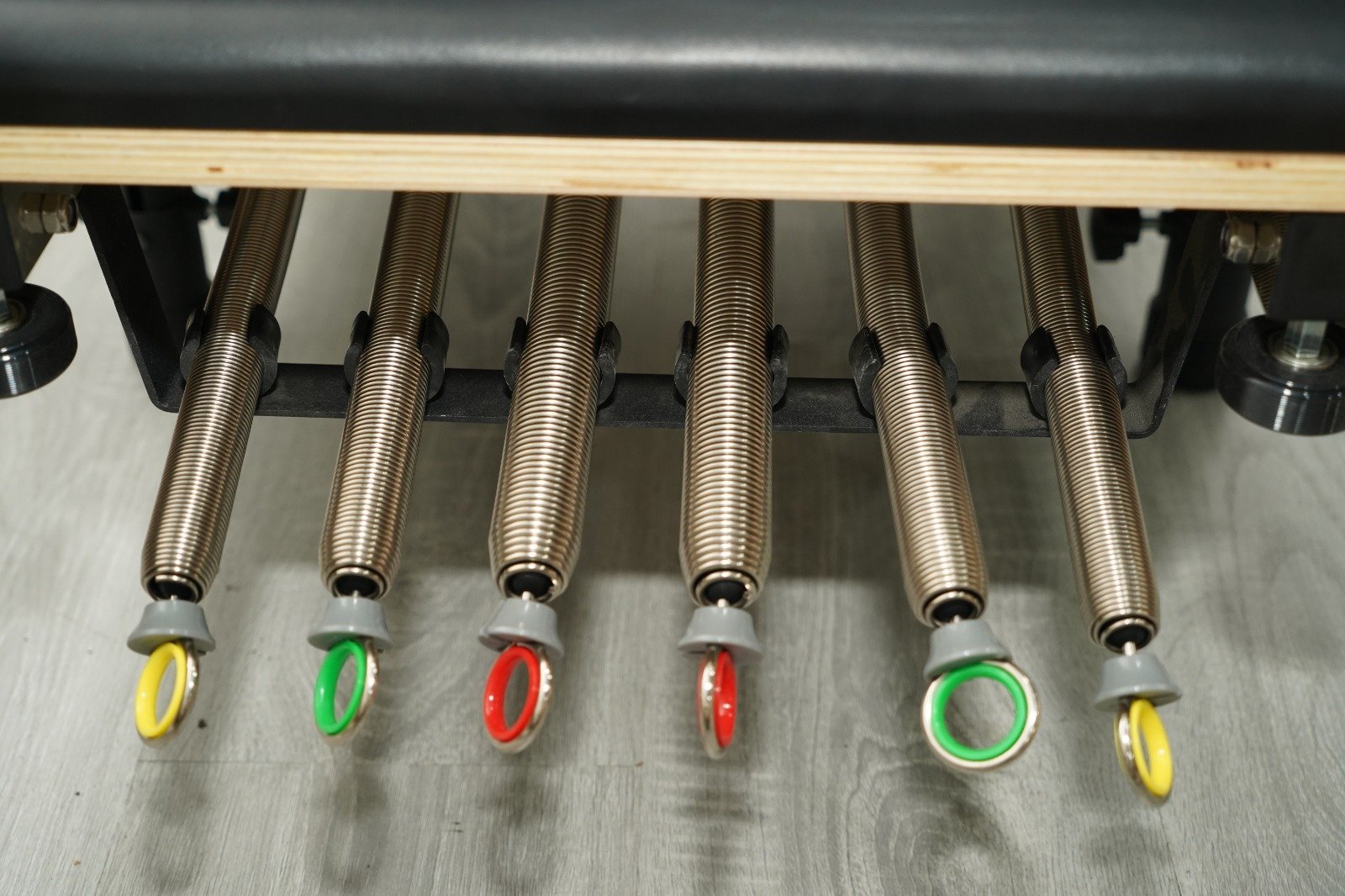
Springs
Function: Provide the adjustable resistance the Reformer is built around, storing and releasing energy as the carriage moves.
Why it wears: Repeated stretch cycles fatigue the steel, concentrating stress at the hook ends — the same points most exposed to corrosion.
Typical service life: One to three years in commercial use is commonly cited before resistance becomes noticeably inconsistent; home use extends this considerably. Highly usage-dependent.
Signs of wear: Resistance differs from a same-rated spring, visible elongation, pitting or rust at the hook, gritty stretching, cracking near the hook.
Inspection: Compare against a known-good spring rather than judging in isolation; examine hook ends closely under good light.
Maintenance: Keep dry, avoid humid storage. No lubrication meaningfully extends spring life — this is a wear item, not a serviceable one.
Replacement: Match resistance rating and physical dimensions — free length, wire diameter, hook style. See our spring dimensions guide and complete guide to Pilates springs.
Safety implications: A spring failing under tension can snap back or detach at the hook, releasing stored energy unpredictably.
Common mistakes: Mixing springs by color alone without confirming dimensions; ignoring gradual resistance loss; using a spring with a cracked or corroded hook.
Ropes
Function: Connect the carriage to the pulley and spring system, transmitting resistance through the pulley path.
Why it wears: Constant friction against the pulley groove, flexing, sweat absorption, and UV exposure degrade the fibers — moisture weakens strength internally before it’s visible.
Typical service life: Six months to two years commercially; sun and sweat exposure shorten this — one of the more usage-sensitive parts.
Signs of wear: Fraying, fuzzy fibers, discoloration, stiffness instead of the original supple feel, stretching under normal tension.
Inspection: Run the full length through your fingers, not just the visible section — the pulley-contact segment wears faster and is often partly hidden.
Maintenance: Keep out of direct sun, wipe sweat contact, avoid harsh chemicals on the rope.
Replacement: Match diameter and construction — too thin can slip in the groove, too thick can jam. See our complete guide to Pilates Reformer ropes.
Safety implications: Failure under spring tension can cause the carriage to move suddenly and uncontrollably.
Common mistakes: Checking only the visible length instead of the pulley-contact point; replacing with the wrong diameter because “it looked about the same.”
Straps
Function: Foot and hand loops provide the adjustable connection between the user and the carriage or rope system.
Why it wears: Direct, repeated skin and sweat contact, plus mechanical stress on stitching and buckle with every adjustment.
Typical service life: Roughly six months to two years commercially, depending on how often strap-based exercises are used.
Signs of wear: Loose or popped stitching, fraying webbing, a buckle that no longer holds its adjustment.
Inspection: Check stitching under tension and test the buckle under a firm pull, not just a light one.
Maintenance: Launder or wipe per material and inspect stitching at the same time.
Replacement: Generally simple — most attach via a universal clip or loop rather than a proprietary mount.
Safety implications: Failure while bearing body weight, during standing footwork for instance, can cause a fall.
Common mistakes: Waiting for a complete tear rather than retiring at first stitching failure; not checking straps used less often.
Pulleys
Function: Redirect the rope path from carriage to spring system and back, with the groove shape keeping the rope tracking correctly.
Why it wears: Constant rope friction deforms the groove; the axle bearing wears from rotation; plastic pulleys can become brittle with age and UV regardless of use.
Typical service life: Roughly two to five years commercially — material and build quality vary meaningfully between manufacturers.
Signs of wear: Uneven rope wear pattern, wobble when spun, squeaking, any visible crack including hairline cracks near the axle hole.
Inspection: Spin by hand feeling for roughness or wobble; examine the groove and axle area closely under good light.
Maintenance: Keep free of dust and grit, which abrade the rope; follow manufacturer guidance on lubrication, since many bearings are sealed.
Replacement: Match outer diameter, groove profile, and axle bore precisely. See our complete guide to Pilates Reformer pulleys.
Safety implications: A cracked pulley can fail suddenly under tension, releasing the rope and spring energy without warning.
Common mistakes: Treating a new squeak as background noise; continuing to use a pulley with a visible hairline crack.
Carriage Wheels
Function: Let the carriage glide along the rails smoothly while supporting the user’s full body weight every repetition.
Why it wears: Rolling friction, dust and grit ingress, and gradual hardening or surface cracking of the wheel material with age. Grit is the biggest accelerant.
Typical service life: Roughly three to seven years commercially — one of the parts where manufacturing quality creates the widest gap between brands.
Signs of wear: Grinding or rough glide, carriage pulling to one side, visible flat spots, noticeable side-to-side play.
Inspection: Slide the carriage the full rail length by hand, feeling for roughness or binding, and check the wheel surface for flat spots.
Maintenance: Keep rails clean and dust-free; follow the manufacturer’s specific lubrication guidance, since some rail/wheel combinations run dry by design.
Replacement: One of the highest-variance parts between manufacturers — wheel diameter, bearing bore, and axle mount are often proprietary to the carriage design.
Safety implications: A seized or binding wheel can stop the carriage abruptly mid-exercise, a real jolt or fall risk during faster work.
Common mistakes: Over-lubricating rails, which attracts dust rather than reducing friction; not cleaning rails between back-to-back classes.
Bearings
Function: Reduce friction inside carriage wheels, pulleys, and some hinge points, allowing smooth rotation under load.
Why it wears: Dust past the seal, moisture-driven internal corrosion, cyclic fatigue from high rotation counts, and grease drying out over years.
Typical service life: Tied to the wheel or pulley housing it — commonly several years commercially, heavily dependent on dust exposure and cleaning habits.
Signs of wear: Gritty or grinding feel when rotated by hand, increased play, new noise.
Inspection: Rotate the wheel or pulley by hand and feel and listen for smoothness; any grittiness signals a bearing past its useful life.
Maintenance: Most bearings here are sealed and not meant for user re-greasing; replacing the wheel or pulley as a unit is usually more practical than servicing the bearing alone.
Replacement: Match inner/outer diameter and width exactly — some machines use standard sizes, others proprietary ones. Confirm before ordering.
Safety implications: Same sudden-stop risk described under carriage wheels.
Common mistakes: Assuming every bearing is generic and easily replaceable when some are proprietary.
Footbar Grips
Function: The rubber or textured covering on the footbar provides traction during footwork and upper-body exercises.
Why it wears: Repeated pressure combined with sweat and skin oils smooths the texture and softens or hardens the rubber compound.
Typical service life: Roughly one to three years commercially, driven mainly by class volume rather than calendar time.
Signs of wear: Smooth, slick patches where texture has worn away, cracking, peeling, a hardened feel.
Inspection: Run a hand across the grip and compare texture and firmness to an unworn section.
Maintenance: Clean regularly to remove sweat and oil buildup; avoid harsh solvents that dry out the compound.
Replacement: Typically a sleeve or wrap that must match the footbar tube diameter.
Safety implications: A worn, slick grip reduces traction exactly where feet bear load — a meaningful slip risk standing or on the jumpboard.
Common mistakes: Waiting until completely smooth before replacing; assuming odor is purely hygiene when residual sweat film also reduces grip.
Shoulder Rests
Function: Padded, adjustable blocks that keep the body positioned on the carriage during supine exercises.
Why it wears: Covering (often vinyl) cracks or peels with age and UV; foam compresses over years; the adjustment mechanism can loosen.
Typical service life: Roughly three to seven years commercially for padding and covering; adjustment hardware often lasts longer if kept clean.
Signs of wear: Cracked or peeling covering, visibly flattened padding, wobble when pressed.
Inspection: Press-test padding firmness against a new reference, check the covering, confirm the clamp holds securely.
Maintenance: Wipe clean, keep out of direct sun, don’t use as a weight-bearing support beyond its intended function.
Replacement: Pad and cover are often sold together; some manufacturers sell the cover separately.
Safety implications: Generally low, though a wobbly rest can shift position during a dynamic exercise.
Common mistakes: Not fully tightening the adjustment clamp, which then loosens gradually during use.
Headrest Hinges
Function: The pivot mechanism lets the headrest fold flat or set at an angle, usually via a friction or ratchet element.
Why it wears: Mechanical wear at the pivot, gradual weakening of any spring-loaded element, and mounting screws that can loosen.
Typical service life: Often five or more years commercially — one of the slower-wearing mechanical parts.
Signs of wear: No longer holds its angle, sags under light pressure, wobbles, grinds when adjusted.
Inspection: Cycle through the full range of motion feeling for resistance, binding, or unexpected play.
Maintenance: Keep the pivot free of debris and periodically confirm mounting screws are tight.
Replacement: Usually brand-specific, often requiring the exact original part given the internal mechanism.
Safety implications: Low but real — an unexpectedly collapsing headrest can startle or mildly injure a user mid-exercise.
Common mistakes: Ignoring early looseness, which tends to worsen progressively rather than stabilize.
Risers
Function: Change the height or angle of the footbar or jumpboard attachment, locking into set positions.
Why it wears: Repeated engagement and disengagement of the locking mechanism wears the contact surfaces over time.
Typical service life: Often five or more years commercially, similar to headrest hinges given relatively infrequent engagement.
Signs of wear: No longer locks securely, or has noticeable wobble once engaged.
Inspection: Engage the lock fully and apply firm pressure in the directions it will experience in use.
Maintenance: Keep the locking mechanism free of dust and grit that can prevent full engagement.
Replacement: Brand-specific in most cases, tied to the footbar or jumpboard system.
Safety implications: Meaningful during jumpboard use, where the riser is under dynamic, repeated load.
Common mistakes: Forcing a worn locking mechanism into position instead of retiring the riser.
Snap Hooks
Function: Spring-loaded metal hooks connect springs or ropes to the carriage or bar for quick attachment.
Why it wears: The internal spring fatigues from repeated opening and closing; the gate and body corrode from sweat exposure like other hardware.
Typical service life: Roughly two to five years commercially, though a hook should be retired immediately at any functional failure regardless of age.
Signs of wear: Gate doesn’t snap fully closed, visible corrosion or pitting, looseness in the pivot pin.
Inspection: Open and release the gate several times, confirming it fully closes every time, and check the pivot for corrosion.
Maintenance: Keep dry; light lubrication on the pivot pin can help, per manufacturer guidance.
Replacement: Match hook size, gate opening, and rated load — not a part to substitute casually.
Safety implications: Among the most safety-critical small parts — a gate that fails to stay closed can let a spring or rope detach under tension.
Common mistakes: Continuing to use a hook whose gate doesn’t fully close; using a hook from an unrelated system without checking its rated load.
Carabiners
Function: Used in some spring and rope systems for the same quick-connect purpose as snap hooks.
Why it wears: Same spring-gate fatigue and corrosion exposure as snap hooks.
Typical service life: Roughly two to five years commercially; functional condition matters more than age.
Signs of wear: Gate that doesn’t close fully, visible corrosion, looseness.
Inspection: Cycle the gate and confirm it seats fully closed every time.
Maintenance: Keep dry and free of corrosion; avoid dropping, which can deform the gate.
Replacement: Match load rating and gate size to the original.
Safety implications: Identical to snap hooks — a detachment risk under tension if the gate fails.
Common mistakes: Treating carabiners as interchangeable regardless of rated load.
Rubber Feet
Function: Glides under the frame legs keep the machine stable, prevent slipping, and protect the floor.
Why it wears: Static weight compresses the rubber permanently over years, and the compound hardens and cracks with age from oxidation — driven by time and environment as much as load.
Typical service life: Roughly three to five years, sometimes less in dry or temperature-variable environments.
Signs of wear: Visible cracking, flattening, or the machine shifting slightly during vigorous exercise.
Inspection: Visual check of each foot plus confirming the machine doesn’t creep during normal-intensity use.
Maintenance: Keep the floor underneath clean and avoid extreme temperature exposure.
Replacement: Simple and low-cost — match foot diameter and mounting style.
Safety implications: A rocking or sliding machine during dynamic exercise is a genuine stability and fall risk, easy to underestimate.
Common mistakes: Not noticing gradual machine movement until it has already caused a near-miss.
Upholstery
Function: The vinyl or leather covering over the carriage pad provides a hygienic, cleanable contact surface.
Why it wears: Flexing, UV exposure, body oils, and — very commonly — frequent alcohol-heavy disinfectant wipes, which in our experience is a widely observed accelerant of cracking and seam failure.
Typical service life: Roughly three to seven years commercially, heavily dependent on the cleaning products used.
Signs of wear: Visible cracking, peeling at seams, foam exposed through the covering.
Inspection: Visual check plus a feel test for stiffness or brittleness against an unworn area.
Maintenance: Use a product appropriate for the material rather than the strongest disinfectant available, and limit direct sun exposure.
Replacement: Full recover or reupholstery, matching foam thickness and the original mounting method.
Safety implications: Primarily hygiene and comfort rather than injury risk, though exposed foam can absorb moisture and become genuinely unhygienic.
Common mistakes: Defaulting to the strongest disinfectant on every pass without checking material compatibility — one of the most common causes of premature failure we see.
Foam Padding
Function: Provides cushioning under the upholstery on the carriage and other padded surfaces.
Why it wears: Develops a permanent compression set after enough loading cycles — an expected foam property, not a defect.
Typical service life: Often five or more years commercially before compression becomes clearly noticeable.
Signs of wear: Visibly thinner or flatter padding, or feeling the carriage frame through the pad.
Inspection: Press-test and compare firmness and rebound to a new pad if available.
Maintenance: Nothing meaningfully slows compression beyond keeping it dry — a genuine wear item.
Replacement: Match density and thickness to the original, since these directly affect exercise feel.
Safety implications: Minimal — mostly comfort, though very thin padding over a hard edge can contribute to pressure discomfort.
Common mistakes: Treating flattened padding as purely cosmetic rather than a recurring wear cost.
Bushings
Function: Sacrificial sleeves at pivot points that absorb friction so surrounding metal parts don’t wear against each other.
Why it wears: By design — the bushing is meant to wear instead of the more expensive parts around it; plastic and nylon types can also dry out and crack with age.
Typical service life: Varies considerably by design; several years commercially is a reasonable general expectation, one of the less standardized parts across the industry.
Signs of wear: Increased play at the joint, or grinding as the bushing wears through to metal-on-metal contact.
Inspection: Check for play at pivot points that shouldn’t have any, against a known-good joint.
Maintenance: Some materials accept light lubrication; self-lubricating polymer types generally should not be oiled. Check before applying anything.
Replacement: Low material cost, but dimensions must match exactly.
Safety implications: Mostly indirect — unaddressed wear eventually leads to metal-on-metal wear at the joint.
Common mistakes: Not noticing wear until play has developed; substituting the wrong material.
Fasteners
Function: Bolts, screws, and nuts hold the frame, rails, footbar, and spring bar together — every load path runs through one.
Why it wears: Vibration and cyclic loading cause self-loosening over time — a well-documented mechanical phenomenon — while repeated removal wears threads and exposed hardware corrodes.
Typical service life: Not a lifespan item — periodic tightening matters more than scheduled replacement, unless a fastener is corroded, stripped, or the wrong grade.
Signs of wear: Visible looseness, new rattling or creaking, visible rust on exposed hardware.
Inspection: Periodic hand-tightness check across all accessible fasteners, noting any new noise.
Maintenance: Re-tighten on a schedule; some technicians use thread-locking compound on fasteners that repeatedly loosen.
Replacement: Straightforward if thread, length, and head type match — the wrong grade or length on a structural joint is a real safety issue.
Safety implications: Among the most safety-relevant issues on the machine, precisely because they’re inexpensive and easy to overlook.
Common mistakes: Over-tightening and stripping threads or cracking a mounting point; ignoring rattles; mixing metric and imperial hardware.
Components That Rarely Need Replacement
Not everything on a Reformer is a wear item. The structural components below are typically sized with a substantial engineering margin above the loads they see in use, so under normal conditions they aren’t expected to fail from gradual wear within a realistic service life. Impact damage, a manufacturing defect, or long-term moisture exposure can still affect them — but routine exercise loading, by itself, is not a meaningful wear mechanism.
- Frame — steel or aluminum, built to carry loads far beyond exercise forces. Corrosion in humid environments is the main long-term threat, not fatigue from use.
- Aluminium rails — highly resistant to rolling contact; grit ground repeatedly into the surface over the very long term is a maintenance issue, not an intrinsic material limit.
- Wood structure — solid wood or high-grade plywood can last decades if kept reasonably dry; moisture-driven warping is the real risk, not mechanical wear.
- Legs — structural, low-stress under normal use; wear here is essentially never the practical concern.
- Tower uprights — carry the same generous safety margin as the rest of the frame.
- Cross members — internal bracing that, like the rest of the structural frame, isn’t a realistic wear item under ordinary use.
This is also why the Components hub on this site focuses heavily on the parts above the frame rather than the structural shell — that’s where the wear actually happens.
Cosmetic Wear vs. Functional Wear
Not all visible wear affects performance, and conflating the two leads to two opposite mistakes: replacing parts unnecessarily, or — more dangerous — ignoring wear because “it’s just cosmetic” when it isn’t.
Cosmetic wear includes surface scratches on the frame or rails, faded anodizing or varnish, minor upholstery scuffing that hasn’t cracked, and small paint nicks. None of it affects resistance, motion, or structural integrity.
Functional wear is anything that changes performance or safety: inconsistent spring resistance, a thinning rope, a wobbling pulley, play in a wheel or bushing, a loose fastener, or upholstery cracked enough to expose foam. This is the wear that requires action.
The practical rule: if worn area doesn’t change resistance, motion, grip, or structural tightness, it’s cosmetic. If it does, it’s functional — regardless of how minor it looks.
Hidden Problems That Can Be Dangerous
The wear that causes the most serious incidents is often the wear you can’t see at a glance:
- Spring fatigue — a fatigued spring can look normal externally while resistance and structural margin have already dropped. Comparison testing matters more than a visual check.
- Damaged bearings — often not visible without disassembly; rotating by hand and checking for grittiness or play is the practical alternative.
- Cracked pulleys — a hairline crack near the axle hole is easy to miss without close, well-lit inspection, and precedes sudden failure under load.
- Worn ropes at the pulley contact point — the visible length can look fine while the section over the pulley groove is significantly thinner.
- Loose fasteners in covered areas — hardware under upholstery or inside the frame doesn’t get a casual visual check, which is exactly why a deliberate schedule matters.
- Hidden corrosion — moisture inside tubing or under upholstery can corrode metal from the inside out before surface rust is visible.
Inspection Schedule
A general framework, not a manufacturer-issued schedule — increase frequency for high-volume commercial use, decrease for lighter home use.
| Frequency | What to check |
|---|---|
| Daily | Carriage glides smoothly, ropes and straps look intact, no obviously loose parts, footbar grip is in good condition, rubber feet are seated, upholstery is clean. |
| Weekly | Spring hooks and attachment points, pulley condition, headrest and shoulder rest mechanisms, any new noises reported by instructors. |
| Monthly | Rope wear at the pulley contact point, carriage wheel movement for grit or binding, tightness on the most frequently accessed fasteners. |
| Quarterly | Full accessible-fastener check, spring tension comparison test, pulley and bearing rotation feel test, upholstery integrity check. |
| Yearly | Comprehensive inspection, ideally by a qualified technician: springs, ropes, pulleys, wheels and bearings, bushings, structural fasteners, overall frame condition, and a replacement plan for parts nearing end of service life. |
Expected Service Life
These ranges reflect commonly reported experience in commercial studio settings, not manufacturer-guaranteed figures. Actual life depends heavily on usage intensity, climate, cleaning products, and build quality. Where a component’s life isn’t tied to a calendar, we’ve noted that instead of inventing a number.
| Component | Typical lifespan (commercial) | Inspection frequency | Replacement recommendation | Important notes |
|---|---|---|---|---|
| Springs | 1–3 years | Monthly visual, quarterly tension check | At first inconsistent resistance vs. a reference spring, or hook damage | Heavily usage-dependent; humidity accelerates corrosion |
| Ropes | 6 months–2 years | Weekly visual, monthly full-length check | At first fraying or stiffening | UV and sweat are the biggest variables |
| Straps | 6 months–2 years | Weekly | At first stitching or webbing wear | Depends on contact frequency |
| Pulleys | 2–5 years | Monthly | At first crack or bearing wobble, regardless of age | Material quality varies by manufacturer |
| Carriage wheels & bearings | 3–7 years | Monthly movement check, quarterly close inspection | At first roughness, play, or flat-spotting | Highest cost and brand-to-brand variance |
| Footbar grips | 1–3 years | Monthly | Once texture is smooth or slick | Sweat exposure is the main driver |
| Shoulder rests | 3–7 years | Quarterly | When foam is compressed or covering cracked | Cosmetic vs. functional distinction matters here |
| Headrest hinges | 5+ years | Quarterly | When it no longer holds position | Often outlasts softer wear parts |
| Risers | 5+ years | Quarterly | If the locking mechanism becomes unreliable | Safety-relevant for jumpboard use |
| Snap hooks & carabiners | 2–5 years | Monthly | At first sign the gate won’t close, or corrosion | One of the more safety-critical small parts |
| Rubber feet | 3–5 years | Quarterly | When cracked, flattened, or the machine shifts | Ages with time, not just use |
| Upholstery | 3–7 years | Quarterly | When cracked or seams fail | Cleaning chemicals significantly affect lifespan |
| Foam padding | 5+ years | Yearly | When compression is clearly noticeable | Mostly comfort, low safety relevance |
| Bushings | Several years, varies by design | Quarterly | When play develops at the joint | Small cost, easy to overlook |
| Fasteners | Not a lifespan item | Monthly/quarterly tightness check | Only if corroded, stripped, or wrong grade | Highly safety-relevant despite low cost |
Preventive Maintenance vs. Corrective Maintenance
Corrective maintenance fixes a part after it has already failed or become unsafe — a snapped rope, a seized wheel, a fastener already loose enough to rattle. Preventive maintenance catches the same issues at the inspection stage, before they reach that point.
The case for prevention is straightforward: replacing a spring or rope on schedule, or at the first sign of wear, is inexpensive and predictable. Replacing it after failure often means an unusable machine during business hours, an instructor managing a startled or injured client, and — depending on what failed — a genuine safety incident rather than a maintenance inconvenience. Preventive maintenance also protects the parts around a failing component: a worn bushing caught early doesn’t get the chance to wear the joint around it; a loose fastener caught early doesn’t work its neighbors loose too.
In practice, the inspection schedule above is what converts a machine’s wear items from unpredictable failures into planned, low-cost replacements.
Original vs. Compatible Replacement Parts
When a wear part needs replacing, studios and technicians generally choose between an OEM part sourced through the machine’s original brand, and a compatible or aftermarket part made to the same dimensions by a different manufacturer.
OEM parts have one clear advantage: guaranteed match to the original specification. The trade-off is usually cost and availability, especially for older or discontinued models.
Compatible parts can be perfectly valid when three things are true: the physical dimensions genuinely match, not just “look similar”; the material and construction are equivalent to what the part needs to do — a spring’s wire gauge and heat treatment, a pulley’s bearing quality, a rope’s fiber and diameter; and the supplier has real quality control rather than variable batch-to-batch tolerances. Where these hold, a compatible part performs the same job for less cost and often better availability.
Compatible parts become a problem when dimensions are approximate, when a supplier can’t state the material specification, or when the part is safety-critical and undocumented — a hook with no clear load rating, for instance. This is exactly the kind of sourcing question we cover in more depth in Buying Pilates Equipment from China: Risks, Costs and Lessons Learned, including how to vet a manufacturer before trusting a compatible part for a load-bearing application.
Neither option is universally correct. The right choice depends on the specific part, how safety-critical it is, how well-documented the compatible option is, and how quickly it’s needed.
Common Maintenance Mistakes
- Judging spring condition by eye instead of comparing resistance to a known-good reference spring.
- Inspecting only the visible length of a rope and missing wear at the pulley contact point.
- Over-lubricating rails or pulleys “to be safe,” which attracts dust and accelerates wear.
- Treating a new squeak, click, or rattle as background noise rather than an early warning.
- Continuing to use hardware with a gate that doesn’t close fully.
- Using the strongest available disinfectant on upholstery without checking material compatibility.
- Waiting until a footbar grip is completely smooth before replacing it.
- Mixing metric and imperial hardware, or fastener grades, on structural joints.
- Assuming all bearings on a machine are generic and interchangeable when some are proprietary.
- Skipping inspection of covered or hidden areas because they’re less convenient to check.
- Replacing a worn part with a compatible option based on appearance alone, without confirming dimensions or material.
- Keeping no record of what’s been replaced and when, making it impossible to notice a part failing early.
- Over-tightening fasteners into wood or composite mounts, stripping the material.
- Letting a known issue “wait until next week” in a busy schedule — how minor wear becomes a safety incident.
Frequently Asked Questions
How often should Reformer springs be replaced?
No fixed interval applies to every machine. One to three years of commercial use before resistance becomes noticeably inconsistent is a common range, but the reliable signal is comparing resistance to a reference spring and checking the hooks for damage.
Can I mix different brands of springs on the same Reformer?
Only if resistance rating and physical dimensions genuinely match — color coding isn’t standardized across manufacturers. See our spring dimensions guide.
Why does my Reformer make a clicking or popping noise?
New noise usually means something has changed mechanically — a loosening fastener, a wearing bearing, or a pulley developing a wobble are the most common causes.
Is it normal for the carriage to feel rough or notchy?
No — a smooth glide is the expected baseline. Roughness usually points to grit on the rails, a wearing wheel, or a bearing issue.
How do I know if a pulley needs replacing?
Spin it by hand for wobble or roughness, and inspect the groove and axle area for cracking. Any crack is a reason to replace it immediately.
Can worn ropes be repaired instead of replaced?
Not in any way that restores original strength. Fraying and thinning reflect real fiber damage and should be replaced, not patched.
Do all Reformers use the same size springs, ropes, and pulleys?
No. Dimensions vary between manufacturers and sometimes between models from the same one. Always confirm exact measurements before ordering.
How much does it typically cost to replace common wear parts?
Costs vary too widely by brand to quote figures here, but as a general pattern: small hardware sits at the low end, ropes and pulleys are moderate, and carriage wheel or bearing assemblies tend to be the most expensive given their brand-specific engineering.
Can I use generic bearings instead of brand-specific ones?
Sometimes — some machines use standard sizes that are widely available; others use proprietary sizes or press-fit assemblies. Confirm before assuming a generic part will fit.
What’s the most dangerous part to ignore if worn?
No single answer, but springs, ropes, pulleys, snap hooks, and structural fasteners all carry the highest safety consequence if allowed to fail rather than caught during inspection — see the risk table below.
How do I extend the life of my Reformer’s ropes?
Keep the machine out of direct sunlight, wipe down sweat contact regularly, and avoid harsh chemicals on the rope. This slows the two biggest accelerants — UV and moisture — without preventing eventual replacement.
Should I lubricate the rails?
Follow the manufacturer’s specific guidance rather than a general rule — some rail and wheel combinations are designed to run dry, and lubricating them can attract dust instead of reducing wear.
Why do Reformers in commercial studios wear out faster than home units?
Cycle count. A machine in six to ten classes a day accumulates in months the cycles a home unit might take years to reach, and every wear mechanism in this guide is accelerated by that multiplier.
Is cosmetic wear — scratches, faded finish — something to worry about?
Generally no, as long as it doesn’t affect resistance, motion, grip, or structural tightness. See the Cosmetic vs. Functional Wear section above.
How do I know if my Reformer’s frame is still structurally sound after years of use?
Check for looseness at every joint, corrosion (especially in humid environments), and impact damage. Under normal use the frame isn’t expected to wear structurally — watch fastener tightness and corrosion, not frame fatigue.
Can worn upholstery affect hygiene?
Yes — once the covering cracks or seams fail, the foam underneath can absorb sweat and moisture, a genuine hygiene concern in a shared commercial setting.
What’s the real difference between OEM and compatible replacement parts?
OEM parts are made by or for the original manufacturer and guaranteed to match specification; compatible parts are made independently to the same dimensions. A well-made compatible part with verified dimensions and materials can perform identically — the risk is in unverified sourcing, not in the concept itself.
Component Risk Overview
The table below is our qualitative technical assessment, based on how each part functions and what happens if its wear goes unaddressed — not a standardized industry rating. Use it to prioritize inspection time, not as a substitute for the component-specific guidance above.
| Component | Probability of Wear | Safety Risk if Ignored | Replacement Cost | Inspection Priority |
|---|---|---|---|---|
| Springs | Very High | High | Low–Medium | ★★★★★ |
| Ropes | Very High | High | Low | ★★★★★ |
| Snap hooks & carabiners | Medium | Very High | Low | ★★★★★ |
| Fasteners | Medium | Very High | Low | ★★★★★ |
| Pulleys | High | High | Low–Medium | ★★★★☆ |
| Carriage wheels | Medium | High | Medium–High | ★★★★☆ |
| Bearings | Medium | High | Medium | ★★★★☆ |
| Straps | High | Medium | Low | ★★★☆☆ |
| Footbar grips | High | Medium | Low | ★★★☆☆ |
| Rubber feet | Medium | Medium | Low | ★★★☆☆ |
| Bushings | Medium | Medium | Low | ★★★☆☆ |
| Risers | Low | Medium | Low–Medium | ★★☆☆☆ |
| Upholstery | High | Low | Medium | ★★☆☆☆ |
| Shoulder rests | Low | Low | Low–Medium | ★★☆☆☆ |
| Headrest hinges | Low | Low | Low–Medium | ★★☆☆☆ |
| Foam padding | Medium | Low | Low–Medium | ★★☆☆☆ |
Conclusion
A well-maintained Reformer can stay safe, accurate, and comfortable to use for decades. Almost none of that comes down to which brand is on the frame — it comes down to whether someone is actually inspecting the parts designed to wear, replacing them before they fail rather than after, and understanding which components need that attention in the first place. The frame will likely outlast the studio itself. The springs, ropes, pulleys, and small hardware won’t — and that’s not a flaw in the machine. It’s simply what these parts are for.
For part-specific detail beyond what’s covered here, see our complete guides to Pilates springs, Reformer ropes, and Reformer pulleys, or browse the full Components hub.