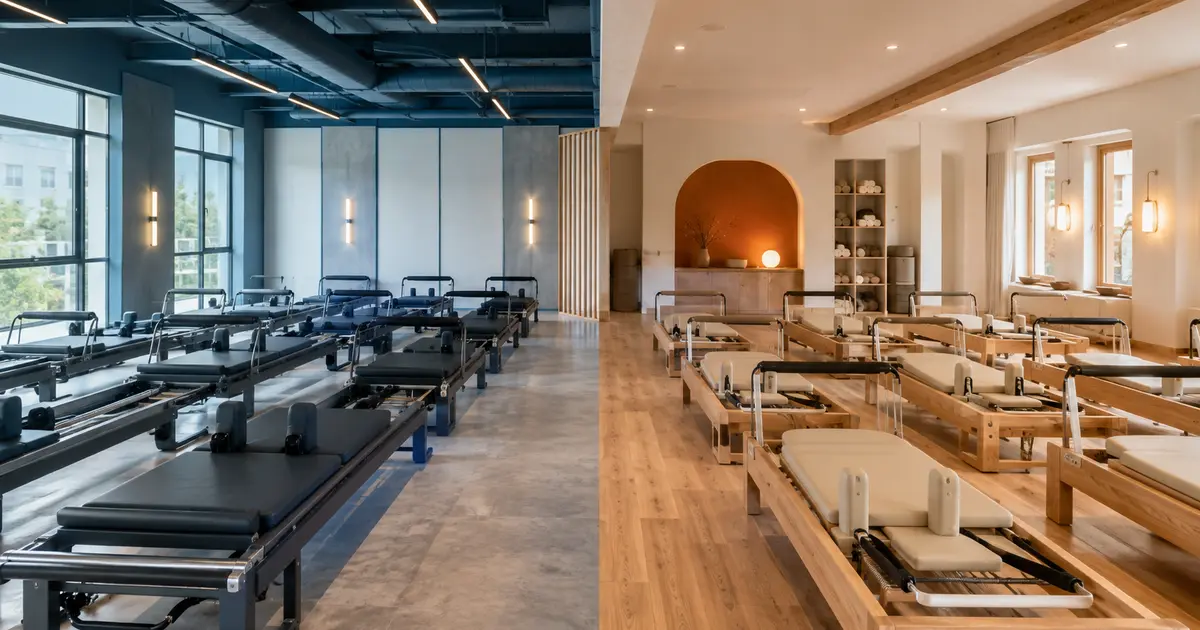
Choosing between a Pilates franchise and an independent studio is primarily a trade of upfront capital and ongoing fees for brand recognition, training systems and supplier relationships — not a guarantee that either path is more profitable. Franchises publish fixed fees and, in some cases, required equipment brands; independent studios carry lower disclosed entry costs but require the owner to build every system, supplier relationship and pricing decision from scratch. This article compares the two ownership models on cost structure, control, supplier freedom, risk and growth path. It does not repeat the full studio-opening budget or reformer price comparison — for detailed 4-to-12-reformer budget scenarios and brand-by-brand equipment pricing, see the complete 2026 Pilates studio opening-cost and reformer-price guide.
This article is general information, not legal or financial advice. Only the signed Franchise Agreement, Franchise Disclosure Document (FDD) and operating manual legally control a specific franchise relationship. Terms vary by brand and can change — verify current figures directly with the franchisor before deciding.
At a Glance: Franchise vs Independent Studio
The table below compares the two ownership models structurally. Where a figure depends on the specific franchise brand, see the named-brand table in the next section rather than a single franchise-wide number — franchise terms are not identical across brands.
| Factor | Franchise | Independent Studio |
|---|---|---|
| Initial franchise/setup fee | One-time fee disclosed per brand (e.g. $60,000–$65,000 among the brands reviewed here) | No franchise fee; setup cost is equipment, buildout and launch expenses — see the opening-cost guide |
| Total launch investment | Disclosed by some brands as a range (varies by brand; see table below) | Owner-controlled; full scenarios in the linked opening-cost guide |
| Ongoing royalty | Recurring percentage of sales; the calculation basis is set in each brand’s FDD — Club Pilates is the only brand in this review that publicly states its royalty and marketing fund are calculated on gross sales | None |
| Marketing/ad fund contribution | Recurring percentage fee, typically separate from royalty; basis set per brand’s FDD | None; owner sets and controls the marketing budget directly |
| Equipment sourcing | May require purchase from a named manufacturer or an approved list, depending on the brand | Full freedom to choose supplier, brand and condition (new or used) |
| Supplier restrictions generally | Franchise Disclosure Document Items 8 and 12 cover supplier and territory restrictions where they exist | None |
| Territory protection | Often included, subject to the specific agreement | Not applicable — no contractual territory system |
| Site selection & lease support | Commonly provided by the franchisor | Owner sources this independently or hires outside help |
| Training provided | Structured initial and ongoing training programs are standard among the brands reviewed | Owner designs or purchases training independently |
| Time to opening | One brand in this review states a typical 9–12 month timeline | Timeline is entirely owner- and contractor-dependent |
| Brand recognition at launch | Pre-existing, backed by the franchisor’s marketing | Built from zero; depends on local reputation and marketing |
| Pricing & class-schedule control | May be constrained by brand standards in the operating manual | Full control |
| Multi-unit expansion path | Structured; some brands report franchisees averaging more than one territory | Owner-designed; no predefined system |
| Exit / resale process | Governed by the franchise agreement’s transfer and approval terms | Owner sells the business as a private asset, without franchisor approval |
| Contractual obligations after signing | Bound by the Franchise Agreement, FDD terms and operating manual for the agreement’s term | No comparable long-term contractual obligation to a third party |
| Risk profile | See the Risk section below — franchise-specific and independent-specific risks differ in kind, not necessarily in size | See the Risk section below |

What a Franchise Actually Provides
It is useful to separate what a franchise agreement contractually obligates the franchisor and franchisee to do, from what is marketed as a benefit but not a guaranteed contractual term. Contractual obligations are set out in the Franchise Disclosure Document, principally Items 5 through 7 (fees), Item 8 (restrictions on sources of products and services), Item 11 (training and assistance), and Item 12 (territory). Among the brands reviewed here, disclosed contractual terms include: an initial franchise fee, an ongoing royalty, a separate marketing fund contribution, and — for at least one brand — a specifically named equipment requirement.
Marketed benefits — brand recognition, “proven” playbooks, real estate scouting support, launch marketing support and ongoing coaching calls — are commonly advertised by franchisors on their public franchise pages, but the specific level of support is set by the individual agreement and operating manual, not by the marketing page. A prospective franchisee should request the actual FDD and read Items 5 through 12 directly rather than relying on a franchise website’s summary.
Current Pilates Franchise Examples
Figures below are quoted from each franchisor’s own public franchise pages as of the access date shown, plus one federal regulatory source for Club Pilates’ franchisor. Where a franchisor does not publish a figure, this table says “not publicly disclosed” rather than estimating one.
| Brand | Initial Franchise Fee | Total Initial Investment | Royalty | Marketing Fund | Equipment Requirement | Minimum Financial Qualification | Disclosed Network Size | Source / Access Date |
|---|---|---|---|---|---|---|---|---|
| Club Pilates | $65,000 | Not publicly disclosed | 8% of gross sales | 2% of gross sales | Manufacturer-direct equipment purchasing coordinated through build-out; no single named model publicly specified | Not publicly disclosed | 1,300+ studios globally; 1,800+ licensed locations | clubpilates.com/franchise/faq (fees, equipment); clubpilates.com/franchise (network size) — accessed 2026-08-19 |
| BODYBAR Pilates | $60,000 | $389,964–$759,356 (median $583,931) | 7% weekly (basis not stated on this page) | 2%, plus a monthly technology fee (basis not stated on this page) | Balanced Body Allegro 2 Reformer with Tower and Mat, plus EXO Chair and Jumpboards (named requirement) | Not publicly disclosed | 90+ studios; 110 franchise owners; 25 states | bodybarpilates.com/franchise/faqs (fees, equipment); bodybarpilates.com/franchise (network size) — accessed 2026-08-19 |
| JETSET Pilates | Not publicly disclosed | $525,540–$749,575 | Not publicly disclosed | Not publicly disclosed | Not publicly specified on the official franchise page | Minimum net worth $500,000; minimum liquid capital $200,000+ | Not publicly disclosed (average owner holds 2.5 territories) | jetsetpilates.com/franchise — accessed 2026-08-19 |
Only BODYBAR names a specific required equipment model publicly. This does not confirm whether Club Pilates or JETSET impose an unstated equipment restriction — see the Equipment and Supplier Freedom section below.
Illustrative Five-Year Franchise Fee Example
Royalties and marketing fund contributions are paid as a percentage of sales, not of profit — they are owed whether or not the studio is profitable in a given period. The example below uses Club Pilates’ publicly disclosed, gross-sales-based fee structure because it is the only brand in this review that states its calculation basis explicitly. It rests on these explicit assumptions: one hypothetical Club Pilates location; constant annual gross sales of $500,000; a five-year period; no annual growth; no inflation; and no tax calculation.
Illustrative Five-Year Franchise Fee Total (N years) = Initial Franchise Fee + Σ [ (Royalty % + Marketing Fund %) × Assumed Annual Gross Sales ] for each year 1 through N.
| Year | Assumed Gross Sales (hypothetical) | Royalty (8%) | Marketing Fund (2%) | Franchise Fee | Year Total |
|---|---|---|---|---|---|
| 1 | $500,000 | $40,000 | $10,000 | $65,000 | $115,000 |
| 2 | $500,000 | $40,000 | $10,000 | — | $50,000 |
| 3 | $500,000 | $40,000 | $10,000 | — | $50,000 |
| 4 | $500,000 | $40,000 | $10,000 | — | $50,000 |
| 5 | $500,000 | $40,000 | $10,000 | — | $50,000 |
| 5-Year Total (illustrative) | $315,000 | ||||
Under these assumptions, $315,000 is an illustrative five-year total of the initial franchise fee, royalty and national marketing contribution — not a real franchisee’s results.
Included in this figure: the one-time initial franchise fee, the ongoing royalty, and the ongoing national marketing fund contribution, all disclosed on Club Pilates’ official franchise FAQ.
Excluded from this figure: technology fees, local advertising, equipment, rent and buildout, payroll, financing, insurance, taxes, renewal or transfer fees, required upgrades, and operating expenses.

What an Independent Studio Must Build Itself
An independent studio has no franchisor providing a pricing template, a class-scheduling system, a staffing structure or a maintenance program — the owner has to build or source each of these directly. Drawing on the experience of operating three independent Pilates studios (without naming them or disclosing confidential figures), a few decisions come up repeatedly:
Pricing: without a franchisor-set price list, an independent owner has to set membership and class pricing against the local market directly, and can adjust it faster than a franchise’s brand-standard pricing typically allows — but also carries the full risk of getting it wrong.
Scheduling: class scheduling has to be built around instructor availability and real local demand patterns from day one, rather than adapted from a franchisor’s standard template.
Staffing: hiring, training and retaining instructors is entirely the owner’s responsibility, with no franchisor-run certification pipeline to draw on.
Equipment and maintenance: an independent owner chooses reformer brand, condition (new or used) and supplier directly, and is responsible for building a maintenance and parts-replacement routine rather than following a brand-mandated equipment and service program.
Suppliers: every vendor relationship — equipment, retail, cleaning, software — is negotiated independently, with no pre-negotiated franchisor vendor agreements to fall back on.
None of this means an independent studio is automatically more profitable or lower-risk than a franchise — it means the same operational decisions a franchise’s systems would otherwise standardize have to be made, and owned, individually.
Equipment and Supplier Freedom
This is the clearest structural difference between the two models, and it is not identical across every franchise. BODYBAR Pilates’ public franchise page names a specific required equipment set: the Balanced Body Allegro 2 Reformer with Tower and Mat, plus EXO Chair and Jumpboards. Club Pilates references “manufacturer-direct equipment purchasing” coordinated through its build-out process, without publicly naming a specific brand. JETSET Pilates’ public franchise page states no equipment requirement at all. This spread is itself the point: do not assume every Pilates franchise imposes the same equipment or supplier restrictions — the real, binding terms are set out in each brand’s individual FDD Item 8 and operating manual, which prospective franchisees should request and read directly.
An independent studio has no such requirement in either direction. That freedom covers reformer brand and condition, tower/Cadillac and chair equipment, spring systems, and replacement-parts sourcing. For the practical side of exercising that freedom, see PSP’s dedicated guides: the used Pilates reformer buying guide, the guide to buying Pilates equipment from China, the reformer parts that wear out guide, and the Pilates reformer springs overview. See the complete 2026 Pilates studio opening-cost and reformer-price guide for full opening-budget figures for equipping an independent studio.
Speed Versus Flexibility
Franchise systems are generally built to compress the time from signing to opening: JETSET Pilates’ public franchise page states that “most studios open within 9 to 12 months,” backed by structured real estate, buildout, marketing and training support. An independent studio has no equivalent built-in timeline — opening speed depends entirely on how quickly the owner can source a lease, complete buildout, hire staff and set up systems. What a franchise buys in speed and structure, it also constrains in flexibility: brand standards, approved equipment or suppliers (where they apply), and operating-manual requirements limit how much an owner can deviate from the system once opened. An independent studio trades a structured timeline for the ability to change pricing, scheduling, branding and suppliers at any time without franchisor approval.
Risk
Franchise and independent ownership carry different categories of risk, not simply more or less risk. Both are summarized below with equivalent depth.
Franchise-side risk factors:
- Ongoing royalty and marketing fund obligations are owed on sales regardless of the studio’s profitability in a given period.
- Equipment, supplier, pricing and branding decisions may be constrained by the operating manual and FDD, reducing the owner’s ability to respond quickly to local market conditions.
- Territory, transfer and renewal terms are set by the franchise agreement, which can affect the owner’s ability to sell or expand on their own terms.
- Regulatory and disclosure risk exists at the franchisor level. In March 2026, the FTC announced a $17 million settlement — which will be returned to franchisees — with Xponential Fitness concerning alleged Franchise Rule violations and related deceptive practices. The FTC identifies Xponential as selling franchises for brands including Club Pilates. The agency’s complaint alleged, among other matters, failures involving accurate and timely franchise disclosures. This is a single, dated regulatory action against one franchisor group, not a statement about Club Pilates franchisees’ individual outcomes, and it is not evidence about any other brand reviewed in this article. See the Due-Diligence Checklist below and the FTC’s official press release for the source.
Independent-side risk factors:
- No brand recognition at launch — every customer relationship and reputation has to be built from zero.
- No pre-built systems for pricing, scheduling, staffing or supplier relationships; mistakes in any of these are made without a tested template to fall back on.
- No structured training pipeline or ongoing coaching calls; the owner is responsible for instructor certification standards and quality control.
- No franchisor-negotiated supplier or real-estate relationships to draw on, which can mean higher search and negotiation costs early on.
- All financial and operational risk sits with the owner directly, with no franchisor support structure to fall back on if a decision goes wrong.
Neither list is exhaustive, and neither model is presented here as inherently safer — the categories of risk differ, and which set matters more depends on the individual owner’s capital, experience and risk tolerance.
Due-Diligence Checklist
This checklist reflects United States federal franchise disclosure law. Franchise law varies by country — if you are evaluating a franchise outside the United States, confirm the applicable disclosure requirements in your own jurisdiction; this checklist should not be treated as globally applicable.
- Under the FTC’s Franchise Rule, a prospective franchisee must receive the Franchise Disclosure Document at least 14 days before being asked to sign any contract or pay any money to the franchisor.
- Request and read FDD Items 5 through 7 for the complete, current fee structure — initial fee, ongoing royalty, marketing fund and any other recurring costs, including the calculation basis for each.
- Request and read FDD Item 8 (and Item 12) directly for the actual equipment, supplier and territory restrictions that apply to that specific brand — do not rely on a franchise website’s marketing summary.
- Request Item 19 if the franchisor makes any financial performance claim, and treat any financial claim not backed by Item 19 with caution, per FTC guidance.
- Request current and former franchisee contact information (also an FDD-required disclosure) and speak directly with owners who have operated the studio for at least a year.
- Check for any regulatory or litigation history involving the franchisor at the federal level — for example, via the FTC’s published press releases — and involving the specific brand’s state-level franchise registration where applicable.
- Have an accountant review the FDD’s financial statements and a franchise-experienced lawyer review the franchise agreement before signing.
Decision Scorecard
This scorecard is a thinking tool to help structure your own decision — it is not financial, legal or franchise advice, and PSP does not offer franchise, legal or financial advisory services. Score each row from 1 (strongly independent-leaning) to 5 (strongly franchise-leaning) based on your own situation, then read the total against the guide beneath the table.
| Factor | 1 (Independent-leaning) | 5 (Franchise-leaning) | Your score (1–5) |
|---|---|---|---|
| Available capital for upfront fees | Limited — prefer lower disclosed entry cost | Sufficient to cover a franchise fee plus ongoing royalty | |
| Comfort with paying fees regardless of monthly profitability | Prefer no recurring third-party fee | Comfortable with an ongoing royalty and marketing fund | |
| Desire for a pre-built operating system | Prefer building your own systems | Prefer a tested playbook and operating manual | |
| Need for brand recognition at launch | Willing to build local reputation from zero | Value walking in with existing brand awareness | |
| Desire for full pricing/schedule/supplier control | Want complete control | Comfortable with brand-standard constraints | |
| Priority on speed to opening | Timeline flexibility is fine | Want a structured, faster path to opening | |
| Multi-unit ambition | Plan to stay single-location or design your own model | Want a defined path to owning multiple territories | |
| Risk tolerance for going it alone | Comfortable carrying all operational risk directly | Prefer shared systems and franchisor support to offset risk |
Reading your total: a lower total (roughly 8–18) suggests your priorities lean toward the control and lower disclosed entry cost of an independent studio; a higher total (roughly 30–40) suggests your priorities lean toward a franchise’s structure and brand support. A mid-range total (roughly 19–29) suggests neither model clearly fits your stated priorities better than the other — treat that as a signal to weigh the Risk and Due-Diligence sections above more heavily, not as a tiebreaker to ignore.
Who Should Choose Each Option
A franchise tends to fit a prospective owner who has the capital to cover both the initial fee and ongoing royalty comfortably, values a tested operating system and brand recognition over full control, and is comfortable with contractual constraints on pricing, equipment or suppliers in exchange for structured support. An independent studio tends to fit a prospective owner who has (or is willing to build) the operational knowledge to run pricing, scheduling, staffing and supplier relationships directly, and prioritizes long-term control and flexibility over a pre-built system. Neither profile guarantees the outcome — both require sufficient capital, operational competence and real due diligence.
Final Verdict
Choose a franchise if the value of a tested system, brand recognition and structured launch timeline is worth an ongoing royalty and marketing fund payable on sales, and you are comfortable operating within a specific brand’s equipment, pricing and supplier terms once you have read that brand’s actual FDD. Choose an independent studio if long-term control over pricing, equipment sourcing, suppliers and brand identity is worth building every operating system yourself, without a franchisor’s ongoing fee. This is a conditional decision, not a universal one: the right choice depends on your available capital, your tolerance for ongoing fees regardless of profitability, and how much you value a pre-built system over full control — use the Decision Scorecard above to weigh those factors against your own situation, and verify every brand-specific figure directly with the franchisor and its current FDD before committing capital.
Frequently Asked Questions
Is a Pilates franchise more profitable than an independent studio?
Neither model is inherently more profitable. Profitability depends on location, management, market demand and execution in both cases. This article does not calculate or claim a profit outcome for either model.
Can I negotiate the royalty or marketing fund percentage with a franchisor?
Franchise fee structures are generally set by the franchisor and disclosed in the FDD; negotiation room, if any, varies by brand and is not something this article can state generally. Ask the franchisor directly.
Do all Pilates franchises require me to buy equipment from an approved vendor?
No — this varies by brand. Among the brands reviewed here, only BODYBAR names a specific required equipment set on its public page; Club Pilates references manufacturer-direct purchasing without naming a brand publicly, and JETSET’s public page states no equipment requirement. Always confirm the actual terms in FDD Item 8 for the specific brand you are evaluating.
What happens if I want to sell my franchise studio later?
Franchise transfers are governed by the transfer and approval terms in the specific franchise agreement, typically requiring franchisor approval. An independent studio can be sold as a private business asset without that approval step.
Is franchise disclosure law the same outside the United States?
No. The 14-day FDD disclosure rule described in this article is a US federal requirement enforced by the FTC. Franchise law varies by country — confirm local requirements if you are evaluating a franchise outside the US.
What should I ask for before signing anything?
At minimum, the current Franchise Disclosure Document (delivered at least 14 days before signing or paying under US federal law), current and former franchisee contact information, and any financial performance claims backed by FDD Item 19. See the Due-Diligence Checklist above.
Does Pilates Spare Parts offer franchise, legal or financial advice?
No. This article and the decision scorecard are general information and a self-assessment tool only. Consult a franchise-experienced accountant and lawyer before signing any agreement.
Where can I find the full budget for opening an independent studio?
See the complete 2026 Pilates studio opening-cost and reformer-price guide, which covers 4-to-12-reformer budget scenarios and brand-by-brand equipment pricing in detail.